Holding Contradictions: An Interview with Ainaz Alipour by Shalini Rana
Before opening the flash section of our April 2026 issue, I was immediately captivated by the girl with red hair that takes center stage in Ainaz’s piece, Skin Upon Skin, featured on the front page of the issue. I had never seen a textile piece with such tenderness and care held in its stitches. I can only imagine the life this piece exudes when experienced in person. When the opportunity to ask Ainaz about their work came up, I jumped at the chance to talk to them for my first Split Lip interview.
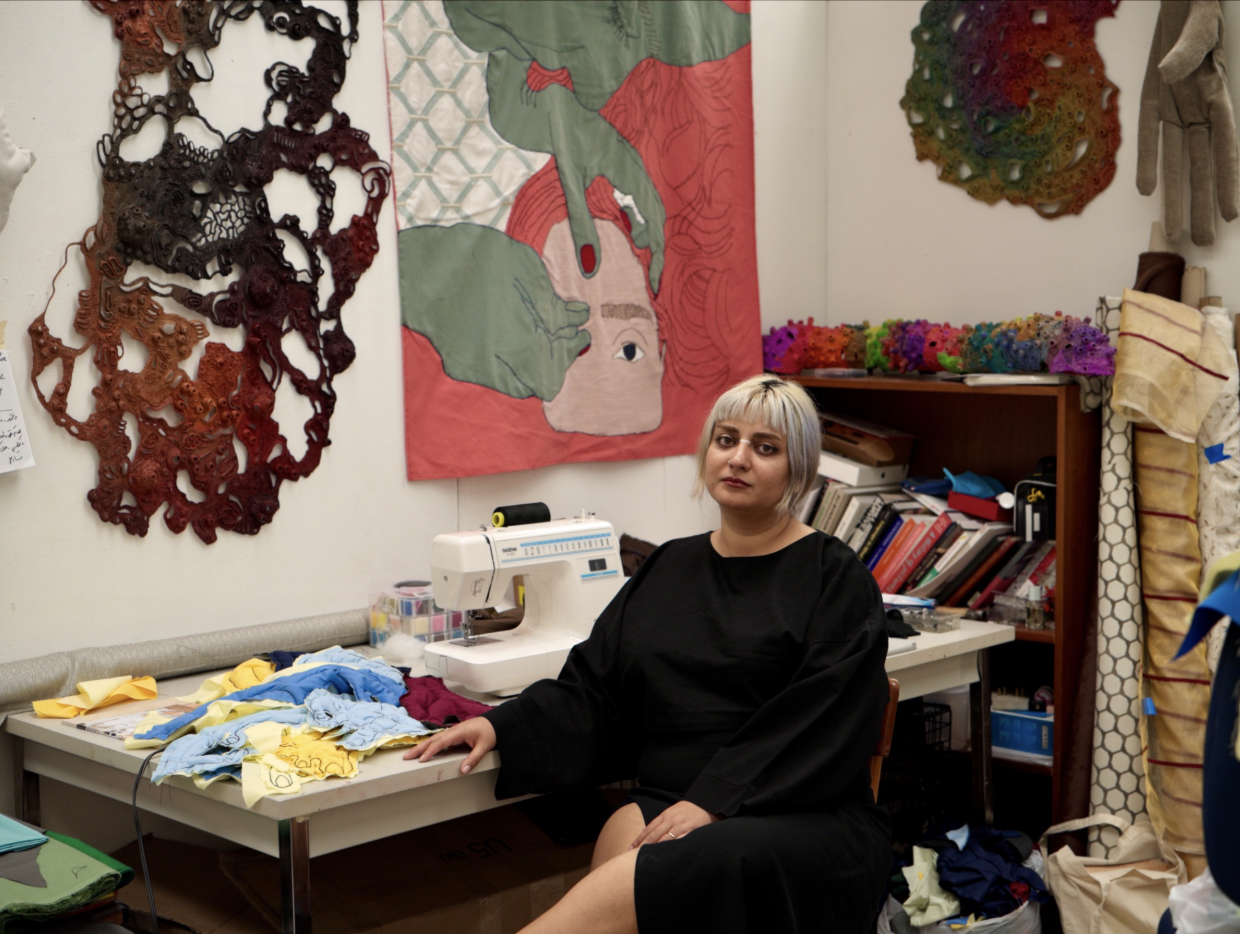
Ainaz Alipour is an Iranian-born artist and educator whose interdisciplinary practice spans textiles, sculpture, digital media, and installation. Their work explores diasporic identity, gendered architectures, and cultural displacement through the intersection of material and digital processes. Ainaz holds an MFA in Studio Arts from the University of South Florida, an MA in Animation and Film from Tarbiat Modares University, and a BFA in Printmaking from the Tehran University of Art. Their work has been exhibited internationally, including at the Ringling Museum of Art, Vox Populi, IceBox Project Space, and Mattie Kelly Art Center, as well as in independent and institutional spaces across Iran. They have participated in residencies such as the Virginia Center for the Creative Arts, MASS MoCA’s Assets for Artists, Vermont Studio Center, Surel’s Place, and On::View, and have received multiple awards and grants. Ainaz’s practice draws from personal archives and Iranian craft traditions to reimagine spatial belonging and embodied memory.
In their free time, Ainaz writes poems and creative pieces in Farsi. They walk their Cavalier King Charles Spaniel (named Cooper, after Agent Cooper from Twin Peaks) and spend weekends in their studio working on their practice while listening to audiobooks. Right now, they are listening to Find Me by André Aciman.
Ainaz and I chatted over email about care as a form of resistance, the relationship between poetry and textiles, and countering fixed narratives.
Shalini Rana: I admire the way Skin Upon Skin holds texture and movement, evoking a sense of tenderness between the two subjects. Can you tell me a bit about what inspired you to make this piece and the process involved in making it?
Ainaz Alipour: The piece is based on a photo I took on my phone when my best friend was plucking my eyebrows. In my 20s in Tehran, I was constantly documenting everyday life. After moving to the U.S. for my MFA, I felt distanced from my female support system, so I started revisiting my photo archive. This was one of the first images I returned to.
I’m interested in care between women and how small, everyday gestures carry intimacy and support. For me, especially in the context of Iranian women, care itself can be a form of resistance. It is about showing up for each other and growing side by side.
In terms of process, I translated images, archival, personal, and imagined, into textile forms. I’m drawn to fabric because it already has a relationship to the body. It holds memory, pressure, and warmth. I used layering and stitching to build a sense of contact, like the surfaces are leaning into each other. Even though the work is still, I think of it as holding a suspended gesture, something that just happened or is about to happen.
SR: I love this origin story. Does Skin Upon Skin feel like it’s in conversation with other pieces you’ve made? Does it feel different in any way?
AA: Yes, very much. It sits within my larger exploration of bodies, textiles, and spatial boundaries, especially how bodies move through spaces that are not always made for them.
My work often centers on female support systems. In more recent pieces, I’ve started to embody these roles myself, becoming sister, mother, daughter, and friend. I find myself actively reconstructing memories based on what I recall, rather than only documenting what has already happened.
Skin Upon Skin feels more intimate and distilled compared to my installations, which are often immersive and architectural. But conceptually, it is very connected. It still deals with thresholds, between visibility and concealment, softness and restriction, interior and exterior space.
SR: Yes. I definitely feel the piece’s intimacy. When and how did you start making art?
AA: I’ve been making things for as long as I can remember. My mom was a traditional oil painter, so there were always materials around, and I remember drawing everywhere, even on my bedroom walls. At the same time, I was drawn to language and creative writing.
When I was about eleven, I started making up rhymes while pushing my little sister in her stroller, and that’s when I first felt I wanted to be a poet. Later, I went to art school for printmaking while also organizing/participating in poetry nights. That gradually led me to filmmaking, then video and digital art, and eventually to working with textiles after learning to sew in grad school. For the past few years, I’ve been making room-scale installations that combine digital and physical elements.
SR: I’m a poet myself, so it is very cool to hear that you were first drawn to poetry. Does the poetry you write (or read) in Farsi influence or interact with your visual art?
AA: Yes, definitely. Even when poetry is not directly present in the work, I think it shapes the way I approach images, pacing, and emotional space. Persian poetry has a very particular relationship to metaphor, intimacy, longing, and fragmentation, and I think those sensibilities carry into my visual language.
I mostly write privately and in Farsi, so it feels connected to a more internal part of myself. Sometimes a line, rhythm, or even a feeling from a poem stays with me while I’m working visually. I’m interested in how both poetry and textiles can hold things indirectly, through suggestion, texture, repetition, and absence rather than direct explanation.
I also think growing up around poetry in Iran shaped the way I understand art more broadly. Poetry was never separate from everyday life there. It was something people quoted casually, emotionally, and politically. That closeness to language still influences how I think about meaning and image-making.
My relationship with words is very intimate. I think a lot about language, about the roots of words and the kinds of meanings or emotions they evoke. My visual work is often representational, so in some ways it operates differently, but writing is always present in my process. I constantly write down sentences, fragments, and poems on paper and pin them to the wall. My studio walls are often covered more in words than in images. I think I live within this layered space of language while I work. Sometimes those writings emerge more literally through titles or themes, and other times they remain in the background, but they are almost always there, even when the connection is not directly visible.
SR: I love that language shapes your process. On another note—do you have a day job? If so, does your job interact with your art-making practice?
AA: I’m an Assistant Professor of Art and Design at Morehead State University, and I just finished my first year of teaching. A tenure-track position can be overwhelming, but also very rewarding. I work during the week for the university and spend my weekends in the studio. This is my first summer in this role, and I’m excited to have a few months more fully dedicated to my practice.
Teaching is very connected to my work. It keeps me in constant dialogue about materials, concepts, and different approaches to making. It also pushes me to articulate things that are often intuitive in my own practice. That back-and-forth between teaching and making is important to me.
SR: Congrats on finishing your first year of teaching! In terms of making, what do you think inspires you to create?
AA: Being human is complicated, and for me, art is a way to stay with that complexity. In the studio, I’m often working through questions rather than answers. That space, where things remain unresolved, is where the work happens.
I’m inspired by personal memory, cultural history, and spatial experience, especially how bodies exist within architectural, social, and political structures. Textiles are important to me because they hold contradictions. They can conceal and reveal, restrict and protect. That tension keeps me engaged and keeps me making.
SR: I agree that the “unresolved” is often where the work or the creative process begins—that’s how it can feel with poetry as well. Is there a particular question you’re exploring right now or want to explore in your studio?
AA: Yes, I think there’s a similarity with poetry in that both often begin in unresolved space, but for me the visual question operates differently. It is less literary and more about visual language, material relationships, and problem-solving. I’m interested in how materials work together and also resist each other.
I work between digital and tangible forms, and I’m drawn to tensions that are often framed as opposites: craft and technology, softness and structure, feminine and masculine. I’m interested in moving away from binary understandings and instead thinking about spaces where those categories become unstable, layered, or fluid. Lately, I’ve been thinking a lot about how marginalized bodies navigate spaces that were not designed for them, both physically and psychologically. I keep returning to ideas around thresholds, visibility, softness, and containment.
I’m especially interested in the relationship between textiles and architecture right now. Fabric can behave almost like a temporary wall or skin. It can divide space while still remaining permeable and vulnerable. I’ve been exploring how suspended textiles, projections, and movement can create environments that feel emotionally charged but also unstable or shifting.
I’m also thinking more about memory and reconstruction. As time passes, I notice that memory becomes less documentary and more speculative. I’m interested in what it means to rebuild personal and cultural memory through fragments, gestures, and material traces rather than fixed narratives.
SR: Wow. I could spend hours with the idea that memory often feels “more speculative” than documentary. Finally—what are your future goals when it comes to your art or career as an artist?
AA: I’m continuously applying to residencies and looking for opportunities to bring my work outside the studio. I’m interested in working with museums and nonprofit organizations, and I value being part of artist communities. Showing up, staying connected, and expanding the reach of my work are all important to me.
I also want to keep expanding my installations, both physically and technologically. I’ve been working more with projection, motion, and immersive environments, and I want to push that further while staying grounded in material processes like textiles and embroidery.
More broadly, I want the work to build spaces that feel both critical and intimate, where different bodies and histories can exist with more agency.
—
Shalini Rana is a poet from Northern Virginia. She is a poetry reader for Split Lip Magazine. Outside of reading and writing, she loves spending time in nature and listening to old records.