What Do You Mean, This Is How We Live? An Interview with Esmé Kaplan-Kinsey
Oceans are the default for life on this planet: where it all started; where most of it is. Oceans challenge our assumptions about what is possible when it comes to ways of being alive. Turn your body inside out! Breathe sulfur! Live forever! Throughout my life as both an artist and scientist, I’ve always thought it was a gift to live like this, steeped in curiosity and anticipation that “Somewhere, something incredible is waiting to be known.”
During the course of my lifetime, humans have come to know incredible things. But what’s been hard for me to watch, hard for me to reconcile, is what we do with this knowledge. Too many decision makers don’t care very much that the world is packed with forms both bonkers and beautiful. Our marvels are their transactions. I think about this as we launch pop stars into space. I think about this when I realize that the customer service representative I just complimented on the phone is a robot. I think about this as I stare at the veiny, plastic truck nuts swaying in front of me at the stoplight, a fate we’ve bestowed upon the remains of a 300-million-year-old tree.
In Esmé Kaplan-Kinsey’s flash fiction, “Jellyfish,” which Split Lip published in January, I sensed the kindred spirit of someone at once awed by the world and humbled by the dumb things humans do in it. “Jellyfish” is part satire, part speculation, all beautiful, and giving voice to an experience I have never seen captured so effectively in the small package of flash fiction. The story does so much in so few words, and I was eager to chat with Esmé over email to learn about their inspiration and process.
Marjee Chmiel: I’d love to hear more about how the idea for Jellyfish came about.
Esmé Kaplan-Kinsey: The premise for this story first came to me through a conversation with a friend whose grandfather had recently undergone a heart transplant. As in the case of the grandfather in “Jellyfish,” it wasn’t his first organ transplant—he’d gotten many over the years. It got me thinking about mortality, our human desire—and increasingly, our technological ability—to evade death, which brought me to the immortal jellyfish. One of my big theses in writing is that many of the concepts we term “fantasy” or “magic” are, in fact, just qualities beyond human capacity. Immortality is the stuff of legends for us; in the case of the jellyfish, it’s simply a fact of life.
Everything within [“Jellyfish”] is completely aligned with the possible, yet alienated from conventions of narrative realism. It’s a goal of mine to write fiction that, rather than employing speculative elements directly, instead draws attention to the already fantastical nature of reality.
MC: What was your editing/ revision process for this piece? How do you know when what is on the page aligns with your vision?
EKK: This story took quite a long time to come together. I rewrote it several times, and it was, in fact, rejected by thirteen other journals before being accepted by Split Lip. Prior to this acceptance, I had come to the conclusion that this piece wasn’t what it needed to be, that something in its mechanics wasn’t quite working. I feel very fortunate and grateful that the Split Lip team not only saw the vision, but also had the resources to go through several rounds of editing to help me execute the work more effectively. It was in these final edits that I felt like the piece really came together; most particularly, the motif of the miracle, which had been hanging around since the beginning of the piece, finally felt fully realized. I think for me, I know a piece is doing the work it should be when any singular part resonates with the rest of what’s there. The other side of this is that the piece would feel incomplete or lopsided if I were to remove any of the material that appears on the page. So usually my revision process is an effort to make more visible the thematic threads that I see undergirding the piece and to pare back parts that feel disconnected.
MC: As someone who works across a variety of genres, I wonder how genre and concept come together. Which one informs the other? Does it come to you as a whole?
EKK: In recent years, I’ve come to understand genre as descriptive rather than prescriptive. I used to sit down thinking, I will write a poem or I will write a short story, and then try to come up with an idea suitable for that format; now, I do my best to start from an idea that sticks with me and just try to write the thing I need to say in whatever form it takes. The only real purpose of making distinction between genres, as far as I can tell, comes in at the very end, when you’re trying to decide where to submit for publication. From this angle, genre boundaries really have more to do with marketing than creative practice, and I find it rather actively detrimental to my process to be thinking about publication before I’ve even written the piece.
Of course, some concepts are clearly more suited to one format or another. But I think this more has to do with container space than with conforming to stylistic guidelines. As an example, a sonnet might be an appropriate shape for an in-the-moment meditation on a species of plant, but it would likely be insufficient for a chronological story exploring this plant’s natural history. But I’m trying to think of my writing in terms of shape and size rather than genre—who says that the natural history wouldn’t work as a longer poem? Why is prose more suitable, other than that it might be more associated with length? The subject necessitates a significant amount of room for discussion, not a particular mode of writing, and certainly not publication in a particular kind of outlet to be effective. So I’m kind of trying to move away from genre constraints in favor of letting my subject material tell me what shape it wants to take. Because it doesn’t matter what category the piece lands in, really, at least until I try to get it published. And I’m trying to move away from that being The Point.
The upshot of this is that I write a lot of things I end up calling stories, things I end up calling poems, and a fair few that I have to flip a coin for. It’s also how I started work on my novel-in-progress, which began as a short story and then simply refused to end. The container space of short fiction turned out to be too small for the story I’m trying to tell, so I’ve had to make it bigger. So I suppose this is something of a dangerous game. It may result in writing something far beyond the bounds of what you anticipated.
MC: Something I notice across your other work is that there is often a strong sense of place. How do you think place influences your writing?
EKK: It makes me happy you’ve identified this quality in my writing, because I do consider myself to be a fundamentally place-based writer. Human stories, and arguably human life itself, is rendered more meaningful when engaged with the more-than-human environment in which it comes to be.
I would not be the person or the writer I am if I had not grown up running through the hills of California, jumping fences and climbing oak trees and watching vultures trace circles in an unbelievably blue sky. My lived experience as a human creature, and therefore my voice as a writer, is embedded in this particular ecosystem. As I travel to and live in new places, they afford me new stories and new words. It’s one of the great joys of changing location. That said, I’ve never stopped writing about my hills. I doubt I ever will. That’s where I first put down roots. The hills know me as well as I know them. They made me possible. I do my best never to forget that in my writing.
I’m a scholar of environmental literature, and I’ve found that situating my writing within its ecological context, whether that be a natural or built environment, is critical to the messages I attempt to convey. I see place not as a foundation or backdrop in front of which a story occurs, despite it often being treated as such in (primarily Western) narrative tradition. Rather, I hope to situate place/location/ecology as a character within my stories, with agency and impact on plot.
Humanity’s destruction of the natural world is inextricably tied to cultural narratives which frame nature as a static source of resources for human consumption, rather than an infinitely complex system of which we are but one tiny part. If we could rewrite these stories, I think behavioral change would not be far behind. So I consider this a large part of my project as a writer: to move my readers towards more positive narratives of relation with the more-than-human world.
MC: Another characteristic I noticed across your work is this sense of awe, particularly around this idea of the diminishment of self, boundaries blurring between living things and living environments. What are the most significant awe experiences in your own life?
EKK: This is a fascinating question. I’ve never thought about my work using the particular terminology of awe, but through your explanation I can see how it’s a rather central theme. I think I never put this word to it because awe is so often associated with vastness/grandeur/majesty/all that jazz. And I think the awe in my work, and in my life, often comes down to the awe inspired by very small or “normal” things.
Perhaps for that reason, I don’t know if I have a standout moment of awe in my life. It’s all kind of baked into the normalcy. Those are the things that get me the most, the ones that arise from mundanity, and those are the things I’m most interested in drawing attention to in my writing. The rainbow on the neck of a pigeon, for example—every time I see a pigeon I look for its rainbow, and I cannot tell you how many times I’ve written about it. Or the first time I went to a live music show after COVID lockdown, I cried in a way I never have before. Not because it was dramatic, but because the beautiful normalcy of people playing music together had been made strange, so I could see it clearly for the first time. I’ve felt awe while riding a horse—that’s a living being who’s letting me sit on his back!—and every time I get on a plane—I don’t believe humans were intended to see clouds from that perspective, yet there I am, hanging in a metal sky tube, drinking ginger ale and wondering when they’ll let me off.
Now that I’m thinking about it, I’m big on defamiliarization as a mechanism for inducing awe, in real life and as a craft tool. Perhaps this is also why I’m often drawn to nonhuman perspectives; they provide a new set of eyes through which to witness the bizarreness of a reality we’ve become desensitized to. Humans default to autopilot, I think. I know I do. Otherwise we’d be running around awestruck all the time. What do you mean, this is how we live? This is what we’ve built? This is what we’ve destroyed? Numbness is a survival strategy and also something of a life sentence. I try to poke holes in that where I can.
MC: I’d love to know more about you as a reader. What reaches out and grabs your attention?
EKK: I am compelled by writing that deals with the intersections of humans, animals, and machines. I like stories told through the eyes of those characters, human and nonhuman, who haven’t historically had chances to tell stories. More broadly, I like stuff that blurs boundaries, that brings attention to the often arbitrary lines drawn between realms of existence, that emphasizes relationality over division. I like deconstruction. I like fluidity. I like queerness as in non-heterosexuality and also as in strangeness and otherness. I like narratives that are “queer” in form as well as in theme. Stuff that makes strange the things we take for granted.
I’m profoundly impressed by written work that deals with the insanity of the modern world, that truly captures the energy of the digital age, and that integrates hypermodern use of language in innovative ways. I find this really difficult, personally, and am always attempting it anyway, so it’s very cool to find a writer who excels at this.
I like writing that puts emphasis on language itself and the role it plays in human lives. I like writing that is aware of itself as writing.
I like stuff that makes me laugh. If the topics are heavy and the writing still makes me laugh, I like it more. I appreciate humor as a path to earnestness. I appreciate earnestness. I find cynicism dull when it functions as a mechanism to avoid earnestness. I don’t think we have time for cynicism. I like writing that is aware of mortality and extinction.
I like writing that knows we only have so much time to say the things we need to say.
—
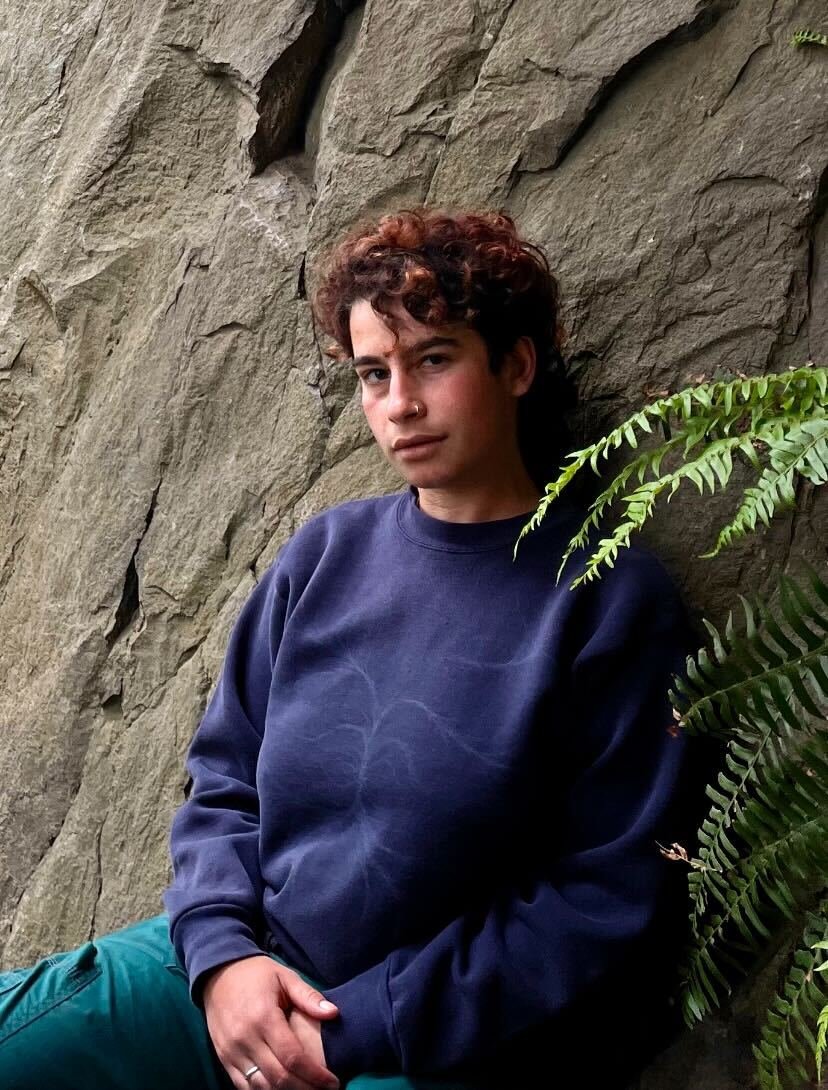
Esmé Kaplan-Kinsey is a California transplant living in Munich, Germany, where they are a Visiting Scholar at the Rachel Carson Center for Environment and Society. A 2026 Anthony Veasna So Scholar through the Adroit Journal and a Monarch Queer Literary Award winner, their work appears in publications such as Split Lip Magazine, SmokeLong Quarterly, and the Cincinnati Review. Their writing explores human-nature relation and deconstructs binaries casting humankind in opposition to the natural world. They are currently writing their first novel.
Marjee Chmiel is a flash fiction reader for Split Lip Magazine. She is a writer, researcher, and documentarian in the Washington DC area. Her work has appeared in BULL, Maudlin House, Flash Fiction Magazine, and Literary Garage with a forthcoming piece in The Literary Hatchet. This fall, she will join the George Mason University creative writing community as a Presidential Fellow in fiction.