
Jellyfish
After the surgery, Grandfather has a new heart.
According to hospital records, the guy who had it first was twenty-two, studied environmental science, and died in a motorcycle accident. He is survived by his pet tarantula, who’s in need of a compassionate new home. There’s a photo of him, the size of a postage stamp, with a real good smile.
Grandfather is ninety-four, and none of his organs are his own. He has the liver of a schoolteacher—a mother of three who had an aneurysm in front of her fourth-grade class—and the kidney of a semi-YouTube-famous rock climber who fastened his harness wrong. Dynamic in life, these people, and lifesaving in death. The dream, really. Grandfather’s torso is covered in scars where his parts have been removed and replaced. He is a composite person, a mosaic of bodies. He is the same as he’s always been—stingy and self-serving, a comforting constant.
In the hospital waiting room, I read a magazine about marine biology. There are creatures in the ocean I’ve never even conceived of. There are neon slugs which expel their guts into the tide when attacked. There are giant squids trailing tentacles as long as city blocks, huge spiderlike crabs sashaying across coral reefs. Most of the world exists down there—all the largest canyons and valleys and mountains populated by life I’ll never encounter. I learn a lot in those hours, ass glued to the beige couch. I feel distantly dismayed about all these things I’ll never see, and not about what’s happening to Grandfather three walls away, and then I feel worse about being both a bad person and a mediocre creature, one who will never travel the depths of the ocean, a double negative—what I am not, and also what I am—a waste of biology, a lopsided organ collection awaiting post-mortem redistribution.
When he wakes up from heart surgery, Grandfather says, “Modern science is a miracle.” He trembles a hand over his chest, smoothing the hospital gown which covers the bandage which covers his old ribcage which covers his new heart. “Just a notch down from immortality, this stuff.”
He’s all slurry with pain medication. I pat him on his sunken cheek, and then I have to go to work at the diner. I fry one hundred over-medium eggs and wash one hundred beige ceramic coffee mugs, and I think about the bottom of the sea, deep blue-black nothing. After eight hours in the hot whir of the kitchen, I can feel my cells aging, frail and irreplaceable.
I go home to put sheets on the pullout couch ready for Grandfather’s wheelchaired arrival, pushed by the part-time aide he refers to exclusively as She. She’s late again. She always burns my mouth with soup. I once learned her name, forgot, and am now in far too deep to ask.
“How are you doing with it all?” She asks me as She’s settling him down into the couch.
“I’m in the market for a miracle,” I tell Her. It’s the wrong word. She wears a gold cross around her neck.
“Lord willing,” She says, “he’ll be doing better with this new heart.”
I don’t have the heart—I would need a whole new one—to tell her the selfish truth: the miracle I need is for me. I’d like to think it’s more of a being-a-person issue than an organ-related deal, but I suppose you never know, living with the body and the brain and the possible not-difference between them. Either way I need a change, a reset, a start-all-over, and quickly. But miracles don’t come cheap. Grandfather’s new form has cost him millions over the years. He shells out for those new gadgets, palpitating and bloody, without second thought. And I have six hundred dollars to my name, and if my heart fails tomorrow that’ll be a simple fix because no one will give me a new one, and it doesn’t look like Grandfather is ever going to get around to leaving me even a dime because he keeps buying new lives from the leftover dead.
And I know what kind of person it makes me to say it. And I wish I was a sea slug so I could expel all the parts of me I carry around even though I don’t want them. And I would watch them float away with the current. And I would feel so stunningly ready to regrow myself from the inside out.
Then it’s a new day, with pills and syrup coaxed into Grandfather’s grumbling mouth, then half a bagel for breakfast, then another eight hours at the diner. When my shift ends, I drive myself home from the restaurant the long way. I consider the possibility of adopting the dead dude’s tarantula, the closest I might get to meeting some many-legged, deep-sea crab. Or perhaps I could trade out my old car for a motorcycle or pursue a degree in environmental science. Maybe I could schedule an appendectomy to shake things up. Or I could just keep waiting for a change of heart.
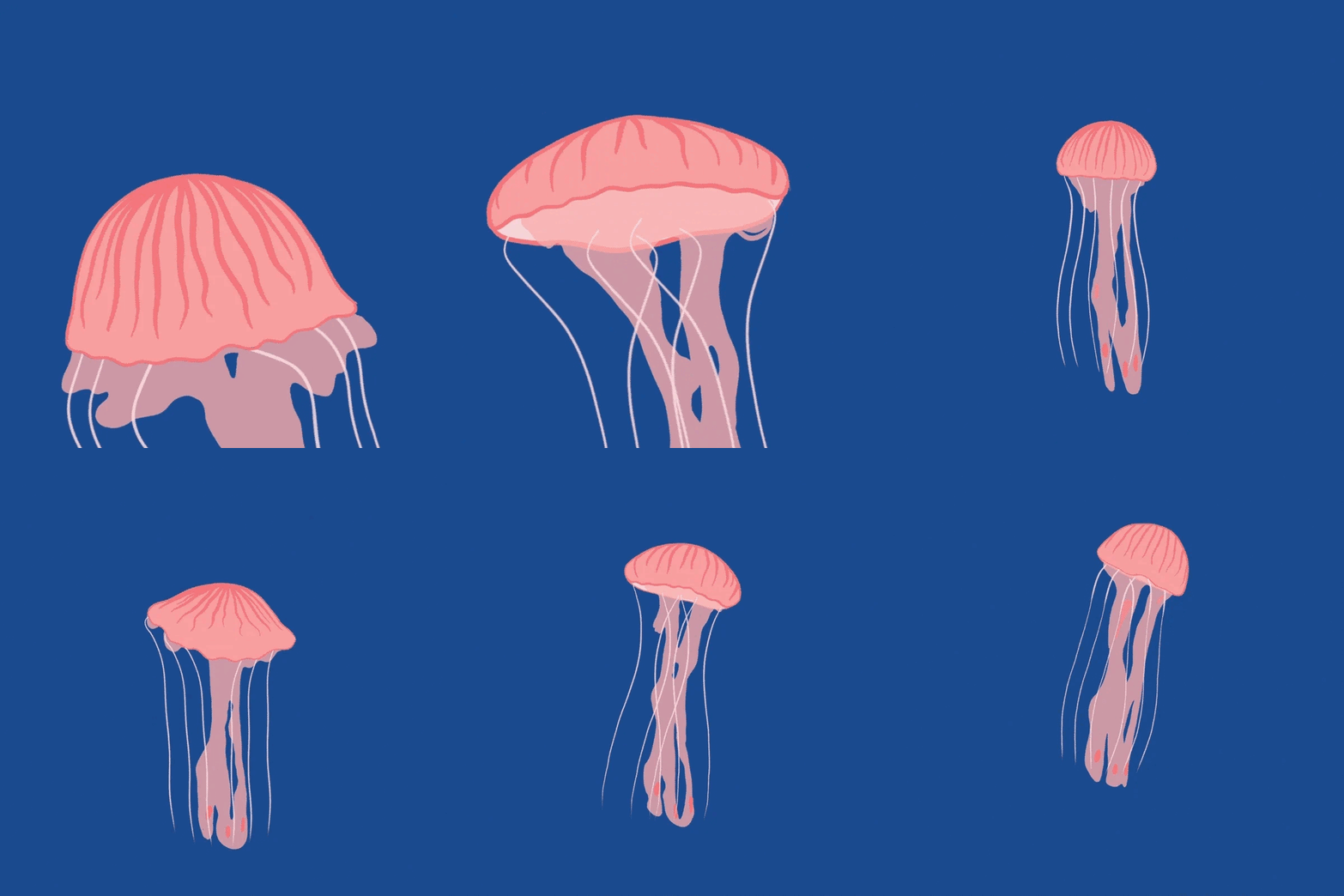
In the very darkest part of the ocean, I read in the waiting room, there is this kind of jellyfish that lives forever. Sounds like fiction, right? So would most things, if they were explained properly. Everything being a miracle, properly. But this jellyfish—it’s really something else. When its body ages to the point of impending death, the cells reverse their growth and become young again. The life cycle starts anew, within the same body. It’s real-world immortal, this jellyfish, it’s figured out what’s still magic for us. How is it possible? Well, isn’t that the question. If we knew, then no one would care about this jellyfish at all.
Esmé Kaplan-Kinsey is a California transplant living in Portland, Oregon. In their writing, they hope to explore human-nature relation and deconstruct binaries that cast humankind in opposition to the natural world. Their work appears in publications such as The Adroit Journal, SmokeLong Quarterly, and The Cincinnati Review. They can be found on X/Bluesky/Instagram @esmepromise.