
A Resistance to Direction: On Chris Campanioni’s north by north/west
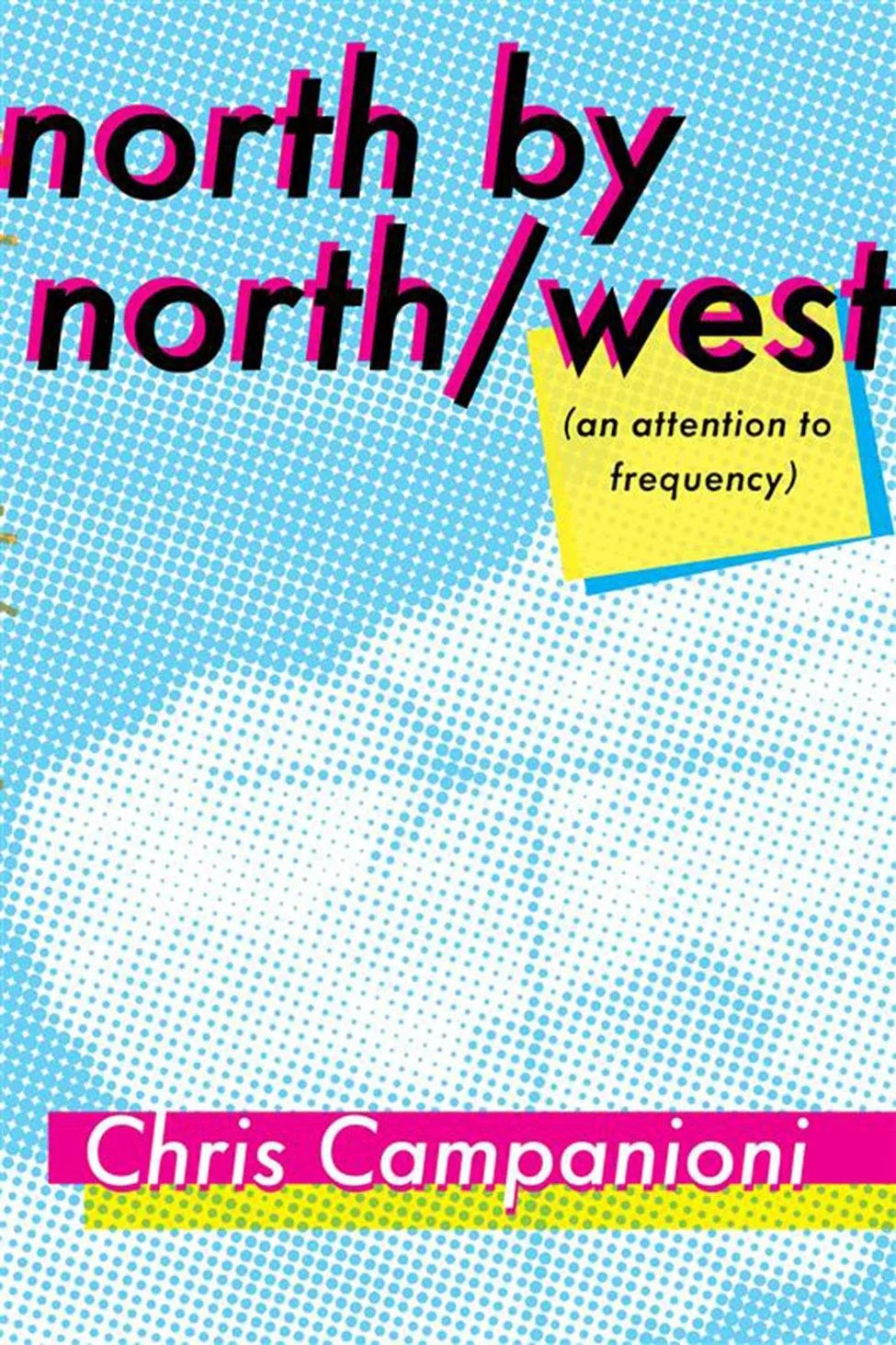
Chris Campanioni’s north by north/west (West Virginia University Press, 2025) is named after a 1959 Hitchcock film, but you don’t need to know anything about the movie as the book isn’t about the movie at all. The book, which straddles different genres and mediums, might explore themes from the film, such as (I’m guessing) location, colonization, and representation. “Might” because I haven’t seen North by Northwest, only the trailer to write this review, and Campanioni writes little about the film. In fact, less than fifty pages from the end, he writes: “It occurs to me that I haven’t yet addressed the film from which this text’s title comes.”
So while I wouldn’t say the film is irrelevant to the book, it’s beside the point. Not that a book needs “a point.” north by north/west can feel at times like it doesn’t have one. Not a single one. According to Merriam-Webster, “point” has seven definitions, including to sharpen, to punctuate, and to direct. (None, at least not in the edition of the dictionary I own, mention “purpose,” which is what I was thinking about when I first used “point.”) Two definitions deal with direction: to direct attention to and AIM, DIRECT. So actually, I suppose that north by north/west is all about points. Each of the word’s seven listed definitions. The book’s nonlinear, stream of consciousness, mosaic-like structure feels directionless. (But what is directionless but a resistance to direction?)
If I was more focused in my writing of this review, I’d have already mentioned the book has a subtitle, but now is as good a time as any to reveal it: (an attention to frequency). I might be more focused in my writing (and in my life) if I got on medication for what I suspect to be Attention Deficit Disorder. Or Attention Deficit Hyperactivity Disorder. Some kind of disorder with my ability to focus—which isn’t to say I can’t stay focused because I can, at times, hyperfocus. (I once read an article that a gift of ADHD is hyperfocus.) I am not making a case for that ability right now.
Should review writing be serious business? I once heard a book review should be art in itself. Art about art. It should give the reader—you—a sense of what it’s like to read a book. I’m trying to offer you that experience. Campanioni writes that he thinks of his genre “as business/casual. I want to be serious. And I want to have fun doing it.” That is what I’m attempting to do in this review. I’m not writing in my typical style of reviewing; my prose here is trying to echo (echo?) north by north/west. (And I am having fun writing this. Can you tell? I can tell Campanioni had fun writing his book.)
But attention to frequency is also attention to patterns. It is noticing parallels. Picking up fragments and arranging narrative threads. Campanioni writes about his mom, Zophie, whose name, after emigrating from Poland, was changed to Sophie, and his dad, Juan, who, after doing the same from Cuba, became John. Name changes as fragmentation of identity, of self. north by north/west includes visual art too: striking photos punctuate (one definition of “point”) the pages of this hybrid work that explores liminal spaces. But despite what some might describe as a collage-like quality, the best word I can find (without the help of my dictionary) to describe the book is “cinematic.” A word derived from “cinema.” (Need I remind you the title comes from a film?)
And yet, the book isn’t ekphrastic. Rather, it uses a film as a starting point (there’s that word again) to build upon. north by north/west is really an exploration, and don’t you need a direction to begin to explore? Campanioni explores a lot of terrain in this book: diasporic identity, migration, culture, language, art, sexuality, refuge, colonialism, creative expression, fragmentation, liminality, formation of identity, writing, exile, attention, listening, land, bodies, assimilation, disappearance, memory, movement, and film. Or maybe film isn’t explored; it’s just the medium used to do the exploring. The boat, if you will.
Campanioni writes about how he would have asked his students about what stories haven’t been written, about what is missing—then offers what he would have told them:
“[T]hat neither my teachers nor the curriculums that they each abided by had ever accounted for the fact that by the end of the Renaissance, ambiguous bodies were translated as fixed and unchangeable; that medical practices involving the body were inextricable from the processes of colonial domination; that the pre-Columbian Americas, which had until then functioned as a space where undecided bodies and queer sexuality flourished, had to be converted to a European, cisgendered, heterosexual norm before they could be completely conquered. To talk about the colonial subject is thus to talk about the queer subject. And to talk about the queer subject is to talk about the subject who has been racialized, made mutable, fungible. We are talking, again, about the migrant, about migration.
That is a long passage to quote, maybe too long for a review of this length, but another thing I’ve been told about reviews is that it’s good to use the text to help make your argument. (What is my argument, you might be wondering. I’m getting to it—just on my own path, on my own time.) Quoting the text also gives the reader (you) the sense of the author’s voice. That quote provides evidence of many of the themes I mentioned in the above paragraph in four (albeit long) sentences. But it’s not the most indicative of Campanioni’s voice, which in that quote seems more authoritative, less poetic than most of the book. And yet—I realize now, writing this—the brilliance of north by north/west is that for a book that deals with movement, even the sentences are in motion, changing, constantly in flux. And so are we all. (Aren’t we?)
I mentioned earlier how I was having fun writing this review. What I didn’t: writing has been a slog. I’ve lost the joy I once found in crafting sentences. I’ve blamed the state of the world, the state of my life. But maybe it’s simply that writing has become too routine, predictable. Maybe I’m too focused on goals, direction. Too concerned about “the point” of it all. Reading north by north/west helped me see how my tight grip on productivity (and the endgame) had killed my creativity. How I have needed to let go. How I have here, in this review, and while I still haven’t gotten to my argument, I’m having fun on the page.
Here is my point: Campanioni’s book, whose title nods to direction, shows us the boundlessness inherent in letting go of directionality. No, more than letting it go—resisting it. How much freedom we find when we allow ourselves to veer off the trodden path. And I don’t just mean imagination—which is essential—but of thought; coming at a time when we’re being encouraged to outsource our thinking to artificial intelligence, to shut up and go along with whatever shit the government doles out next. In its resistance to direction, north by north/west shows us the possibilities we might find when we resist the expected, what is expected of us.
Rachel León (@rachellayown)(she/they) is a writer, editor, and social worker. She serves as Managing Director for Chicago Review of Books and Fiction Director for Arcturus. Her debut novel, How We See the Gray, is forthcoming from Curbstone Books in May 2026.
Chris Campanioni was born in Manhattan and grew up in a very nineties New Jersey. The son of exiles from Cuba and Poland, Campanioni is a writer, multimedia artist, and instructor. He is a recipient of the International Latino Book Award for his debut novel, Going Down (Aignos, 2013); the Pushcart Prize for “Soft Opening” from his cross-genre collection Death of Art (C&R Press, 2016); and the 2013 Academy of American Poets College Prize.