
Ten Years After Being Buried Alive, I Address My Sister-Wife through Our Mothers' Bodies
special thanks to Tarik Dobbs
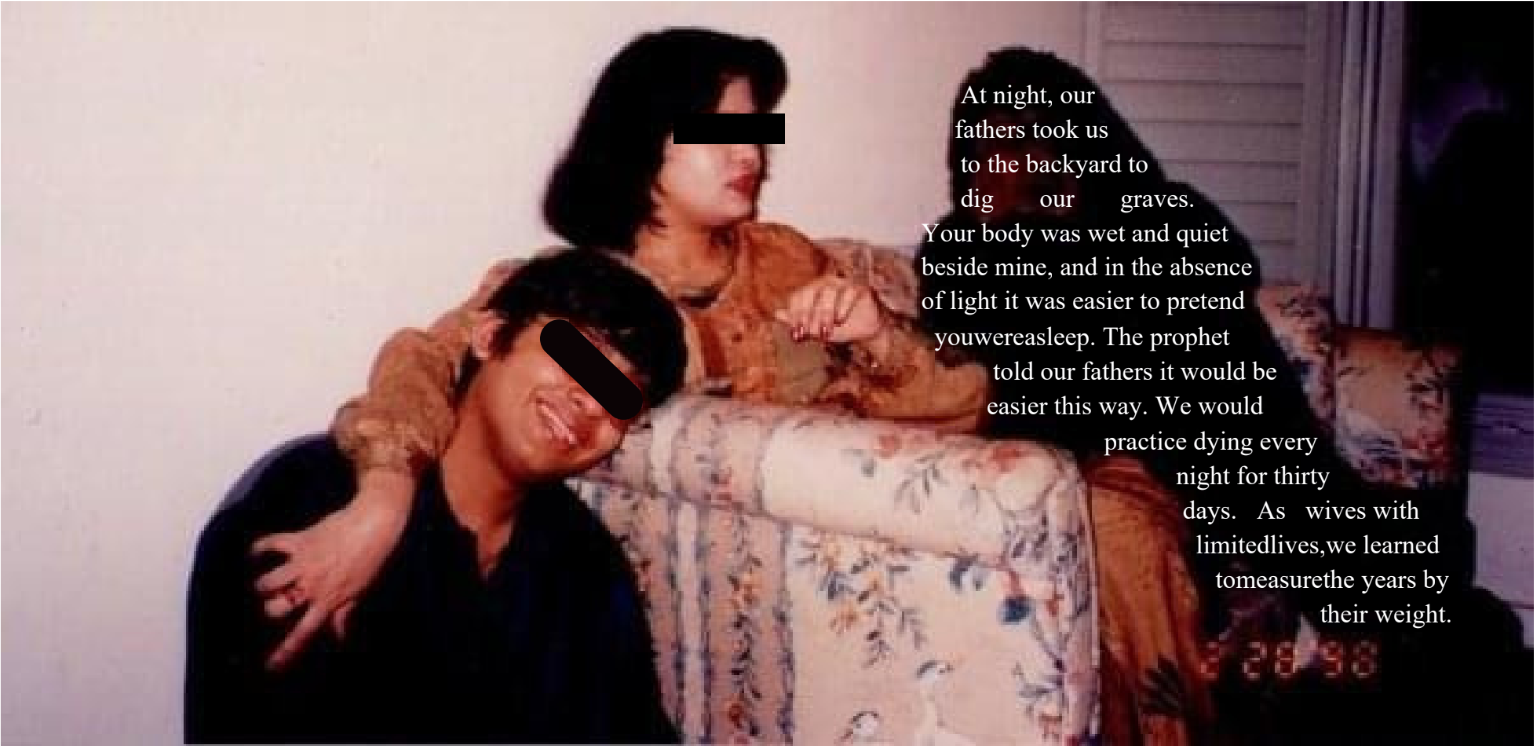
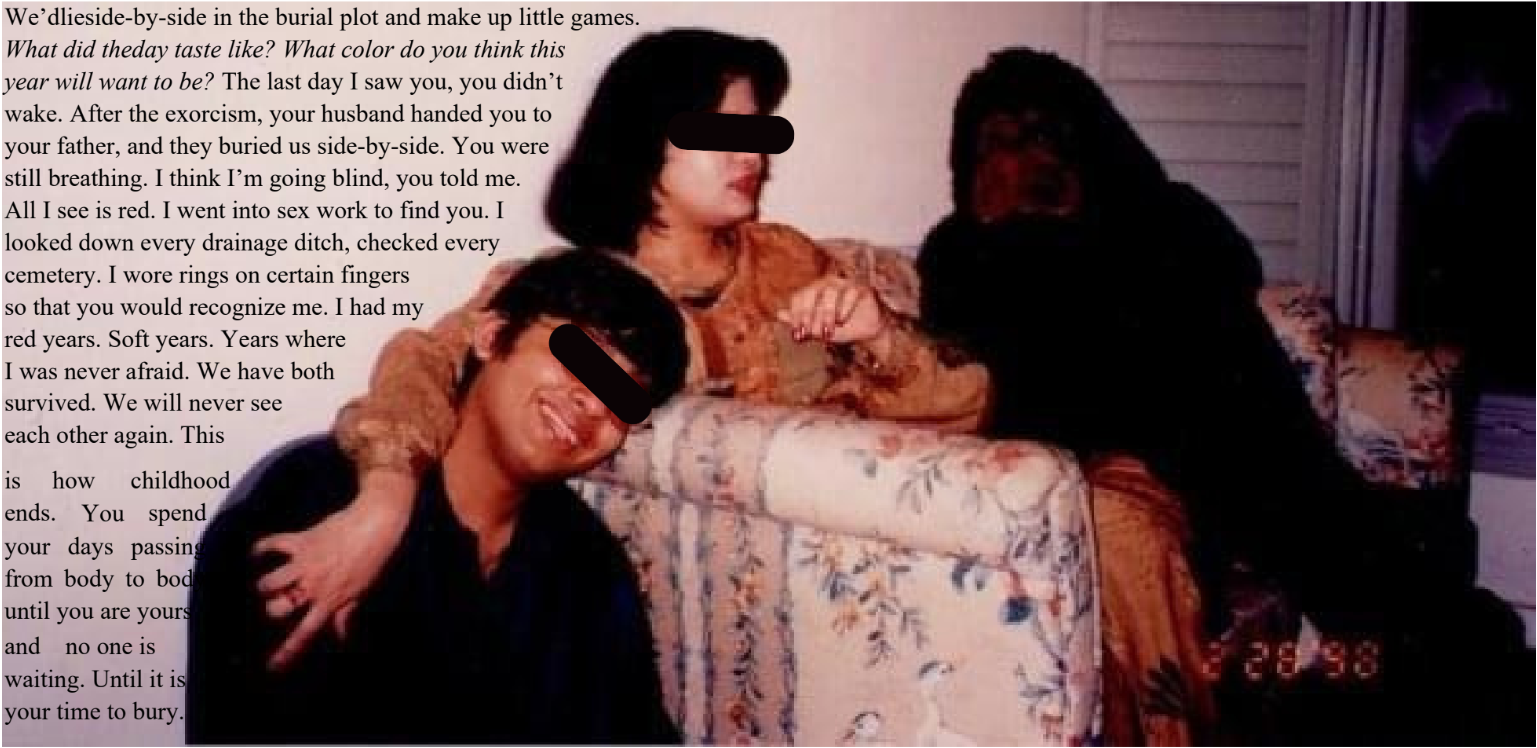
You started your menses at eight years old. I remember how you were unable to look me in the eye when you told me. You refused to speak about it, even though we shared most things, including our husband. Endometriosis is a side effect of childhood [ ], a side effect of silence, I want to tell you, and now every time a piece of my uterus ruptures I wonder if the same deaths occur inside of your body, thousands of miles away. We were good wives. I wonder if your god remembers me. I wonder how you pass your days. I wonder if you are still a wife, if you have children, if you are trying to. I am bringing you into the poem so that you remember, so that I can mold the memory I have of you. I was twelve and you were ten when I miscarried for the first time, and even though we lived alongside God he remained silent while I was small and bleeding in your bathroom, a mass of my own flesh in my hands. In my earliest memory of myself I was begging. You should make your own doll, my brother tells me. Perhaps it will help with the healing. I collect scraps of cloth, beads for jewelry, and even knit a thin scarf that doubles as a dress. At night I spend most of my time thinking about how best to create a body. I am not a god, nor do I want to be. Do you remember my brother, how he was the biggest skeptic at eight years old? How he asked God in front of all the prophets to tell us His story? How God was flattered, but didn’t say anything? How my brother would then ask about the rest of the planets, and God would reply, “Where do you think dreams happen?” Have you ever seen our husband in full lighting? You should know he has very intense eyes. Hazel. The two times he looked straight at me I felt as though I was dying. I am writing for closure, for your permission to be a mother, to be something other. My therapist tells me I need to learn how to name my grief, but how do I tell her that I couldn’t even name my daughter? You have survived and that is all I can ask of you. I am not sure how to keep living without knowing what happens next. Death was a comforting time-keeper. It is hard for me to believe that our myth is over. I am still deciding if I am the monster or if I am the soil the hero wipes his feet on, where I stand in such mythology. My mother speaks of your mother and tells me that she was always evil, that she has been evil for a long time, that she has taken you with her. Look here—for a long time, your mother didn’t even show up in photos! All I can remember are the times we wrote songs together, the times we ran away in the middle of the night to live feral in the woods, how young we were. You’d fall asleep and I’d wait for our husband to come collect me so he’d leave you. I love you. I love you. They cannot take it.
Lydia Abedeen (@lydia_abedeen) is a PhD student in creative writing at the University of Nebraska-Lincoln. She received her MFA+MA at Northwestern’s Litowitz program. She studies cults, ghosts, and the effects religious trauma has on women. A Tin House scholar, her writing has been supported by the University of Iowa, Sundress Academy of the Arts, and the Watering Hole. Her writing is forthcoming and published in The Offing, The Rumpus, Mizna, The Margins, and Hayden’s Ferry Review. Her manuscript, Half-Wife, was a 2024 National Poetry Series finalist.