Surrender
A bunch of mumbling, phone crackling, panicked voices, angry voices, threats, demands. It never stops. The volume of calls feels similar to an insect infestation, incredibly difficult to get rid of. The second I transfer one call out, another comes in. Someone is always on the line, obnoxiously chewing or breathing heavily in my ear. Our tiny office in a remote corner of the hospital has no windows and poor air circulation. The room feels stuffy despite Arizona’s dry climate, and now, thanks to my coworker’s breakfast, it’s pungent with the smell of burnt toast.
Maureen needs cardiology. Peter needs his hearing aid adjusted. Rachel from Cigna needs to know if her member is still inpatient. People too afraid to make decisions for themselves, desperate for reassurance, dial in and list a bunch of symptoms. A penis oozing a foul-smelling discharge. Someone’s kid swallowed a nickel. A man wants to donate his own blood before surgery on the off chance he needs a transfusion—says he refuses vaccinated blood.
I need a bullet to the head, but of course, I don’t say that. It would be reckless of me to risk losing this job. I need it for the cushy health insurance package it provides—a heavily discounted monthly premium with a $250 deductible.
The queue grows and my computer pings with a chat from the supervisor. Three people have called in sick. With only two of us on and twenty calls waiting, I wonder how anyone is meant to work like this.
“Do you think I should bring my mother in or is it nothing to worry about?”
“Well, if you think she is having a stroke, then yeah, you should probably dial 9-1-1.”
“Get me to my doctor’s office now!”
“Sure, who’s your doctor?”
“I don’t know. Why don’t you do your job and look it up?”
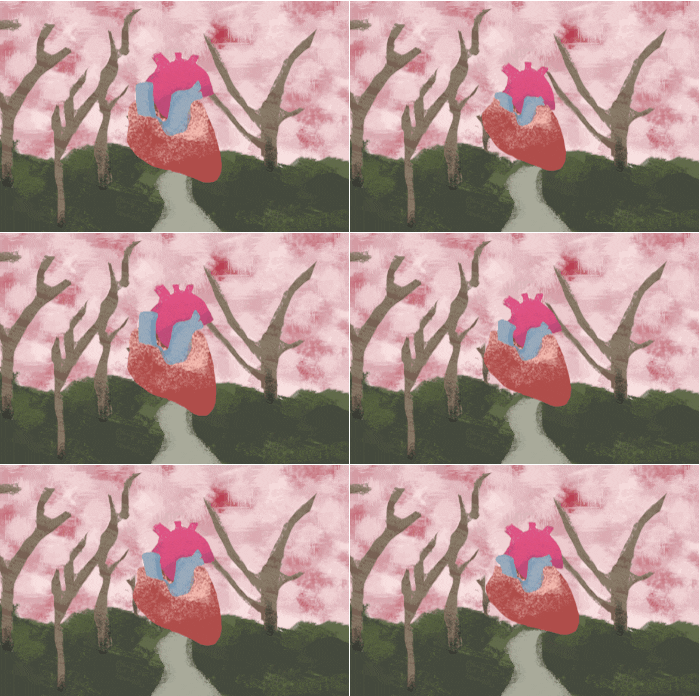
I chew the inside of my cheek hoping that if I bite down hard enough, I’ll taste blood. The pain briefly pulls me away from the dread of this monotonous agony. It’s only 10:30 in the morning and it feels like she’s my 412th call of the day. I want to ask her how stupid one person can be not to know their own doctor but I keep it contained. Maybe that’s a projection from somewhere deep inside of me. I haven’t had the same privilege to move through life unsure of such crucial information. Maybe I’d be blissfully ignorant, too, if I hadn’t been an eleven-year-old transplant patient due to a rare congenital heart defect.
“Oh, there you are,” I lie as I run my fingers across the keyboard. I press enter and randomly send her call to one of the hospital’s twenty-something offices.
I spend my lunch break in the clinic, staring at the ceiling to avoid eye contact while my oncologist examines my breasts. My mind helplessly drifts to the radiation I had when I was twelve to treat organ rejection. Tiny dots forever marked on my skin. Awful bouts of nausea after each treatment. The resident who told me without my parents in the room to watch out for breast cancer when you get older as if he were telling me to bake a carrot cake at 350 degrees for forty minutes.
The oncologist confirms that the risk is high. Cancer is probable. “Hormone therapy is one of the things we can do, but it can mess with your fertility and at twenty-four you’re too young.” Too young, the words linger. I divert my attention out of the window toward the mountain layers in the distance. Floating elsewhere, blankly gazing, I am no longer receiving the words he is speaking. Something about a complete removal of my breasts. A bilateral prophylactic mastectomy.
I freeze at the thought of choosing wrong, haunted by the memory of spending my most formative years having no control over my health. He understands the complexities without me having to say anything. “You don’t have to decide now. We can start to monitor you with yearly imaging.” I nod. He orders a mammogram.
When I return to work, my first call is from a man listing every single neurological issue he has. Equilibrium problems, headaches, vertigo, dizzy spells. He wants to admit himself into the hospital. I tell him that if he feels like he’s having a medical emergency, he can come in through the ER. He refuses to listen, dragging on the conversation. His neighbor hit him in the back of the head with a leaf blower. I shift around in my seat feeling suffocated, seized by anxiety as I watch the number of incoming calls rise.
“Finally, someone,” a man barks into the phone, my next call. He wants to know if he can take his girlfriend’s leftover antibiotics for his own infection and “be good.” When I open my mouth to speak, nothing but air comes out. Without responding, I hang up on him.
“My twenty-two-year-old died at your hospital. You killed her.”
“Did you just call me? I have a missed call from this number. Who is this? What do you want? Where’s Denise?”
I spend my days drowning in the needs of hundreds of others, barely able to keep myself afloat. I visualize ripping my headset off and throwing it across the room before I burst under the fluorescent lights into thousands of confetti pieces. Hello? Hello? They’ll singsong into the headset. Are you still there? Hello? Rude bitch. But I’ll be long gone, everywhere and nowhere, a better place.
At the end of my shift, I get a text from the pharmacy letting me know my prescriptions are ready for pick up. The cashier at the counter asks if I want my paperwork. I decline. I know what the papers say. I don’t need to be reminded. I’ve been on these pills for over a decade. Before that, it was terrible tasting liquids: Digoxin, Furosemide, Enalapril—a cocktail of heart failure medications for a nine-year-old girl.
When I take the orange bottles out of the paper bag, the papers I refused fall out. First, I see the price they billed to my insurance: $4,000. Then my eyes fixate on the words in bold: Carcinogenic, do not use if pregnant or trying to conceive, may cause infertility. I wanted so desperately for my transplant to be the answer, a cure. It has mostly been a trade-off.
The following week, I have an appointment with the cardiologist. Our meeting is routine, brief. He sends new scripts to the pharmacy, encourages me to continue walking, then orders two pages of lab work, a chest X-ray, an EKG, an echocardiogram, and a nuclear stress test. Every year I wonder how I’m supposed to pay for all of this. I never ask.
At the hospital in preparation for my stress test, a timid student ties a blue tourniquet around my arm. Her face is obscenely close to me as she looks for the perfect place to poke. “Get ready to count to three, okay?” Before realizing I don’t want to count, she sticks the needle into me. Unsuccessful at inserting the IV, she tries again and misses. As she digs around for my vein, I wince. I open my mouth to tell her that she’s hurting me but purse my lips instead. It’s better to stay quiet. After all, it’s a miracle that I’m alive. I should be more grateful.
One of the nurses observes her struggle and walks over too cheery for how early it is. He takes over, untying and retying the tourniquet. His ungloved, dry hands glide over my skin. He notices the I love you tattoo just above the crook of my elbow. “Oh, I love you too,” he says and laughs in a way that irritates me. I hate him. For a second, I consider saying, “Yeah, it’s my dead mother’s handwriting,” but I chuckle awkwardly instead. Better to just be polite and smile.
In the imaging room, the machine beeps and rotates around me. I have difficulty staying still, and my mind drifts. I think of my boyfriend with his big green eyes. In this daydream, we’re at the beach. “Look at this one,” he says, picking up a seashell from the shore, a pearl iridescent shine to it. “Come here, Atlas,” he calls out to our dog who zooms out of the water and into my lap. We’re both laughing. Back in the imaging room, I think of how the reality of my health affects every aspect of my life and my eyes feel cloudy. Tears fall and I feel my heart rate rising. I think of how bored he must be in the waiting room. Mindlessly scrolling on his phone, glancing up at whatever home improvement show is playing on HGTV. Why did I let him come with me? I’m anticipating, waiting for the moment he decides this is too inconvenient, not what he signed up for. How much longer will he stay? Will his love run out? I assume his patience is beginning to falter. He must be tired because I am exhausted.
When the test is over, I sit up at the edge of the table. The student returns offering a hand at removing the EKG stickers. The opening of my gown unravels, leaving me exposed. A bald man in a white coat stands behind the glass window and stares. Our eyes meet and I wish to make him as uncomfortable as he is making me. It doesn’t work. He is composed, confident, giving me a look that says thanks for the free show. I think of all the hands that have touched me, all the pairs of eyes that have seen me. I wonder if my body has ever been mine.
In the bathroom, as I change out of the gown into my normal clothes, the mirror catches my reflection. My shoulders are rolled forward from poor posture. The unpleasant hospital lights reveal my inflamed and textured skin. I hardly recognize myself. I’m curious to know where my joy has gone, if there is any left inside the bleak shell of my body. The thought of returning to work the next day makes my stomach churn. Dissatisfaction gnaws at me as I begin to question my life. An insufferable job that pays just enough to cover my out-of-pocket healthcare costs to give me the illusion of financial stability. Is this all there is?
On my way out, I get a text from my supervisor. Sorry to reach out on your day off. We’re tight on coverage tomorrow. I know you’re scheduled to start at 9, but could you come in at 4am? Unfortunately, we can’t offer you overtime. Your flexibility is greatly appreciated. They continue to ask because they know they can. I give in because I know I don’t have a choice.
The only thing I ever found out about my donor is that they passed away in a car accident. They were sixteen. I often wonder, if our roles had been reversed, where they would be now. I think of the parents and the grief they must carry. If they knew it was me who received their child’s heart, would they be content? At peace? Or would they be disappointed and full of regret? I feel ashamed for involuntarily accepting a gift so extraordinary. I know I need to do more with it, so I vow to surrender and comply. I continue to promise tomorrow. I’ll be better tomorrow. I’ll find my way out of this tomorrow.
Maria Lata (@yerrrmaria) is a writer from Queens, NY. Her work often explores chronic illness, bodies, and girlhood. She currently lives in Phoenix.