
Love the Mess: An Interview with Kate Broad, Author of Greenwich
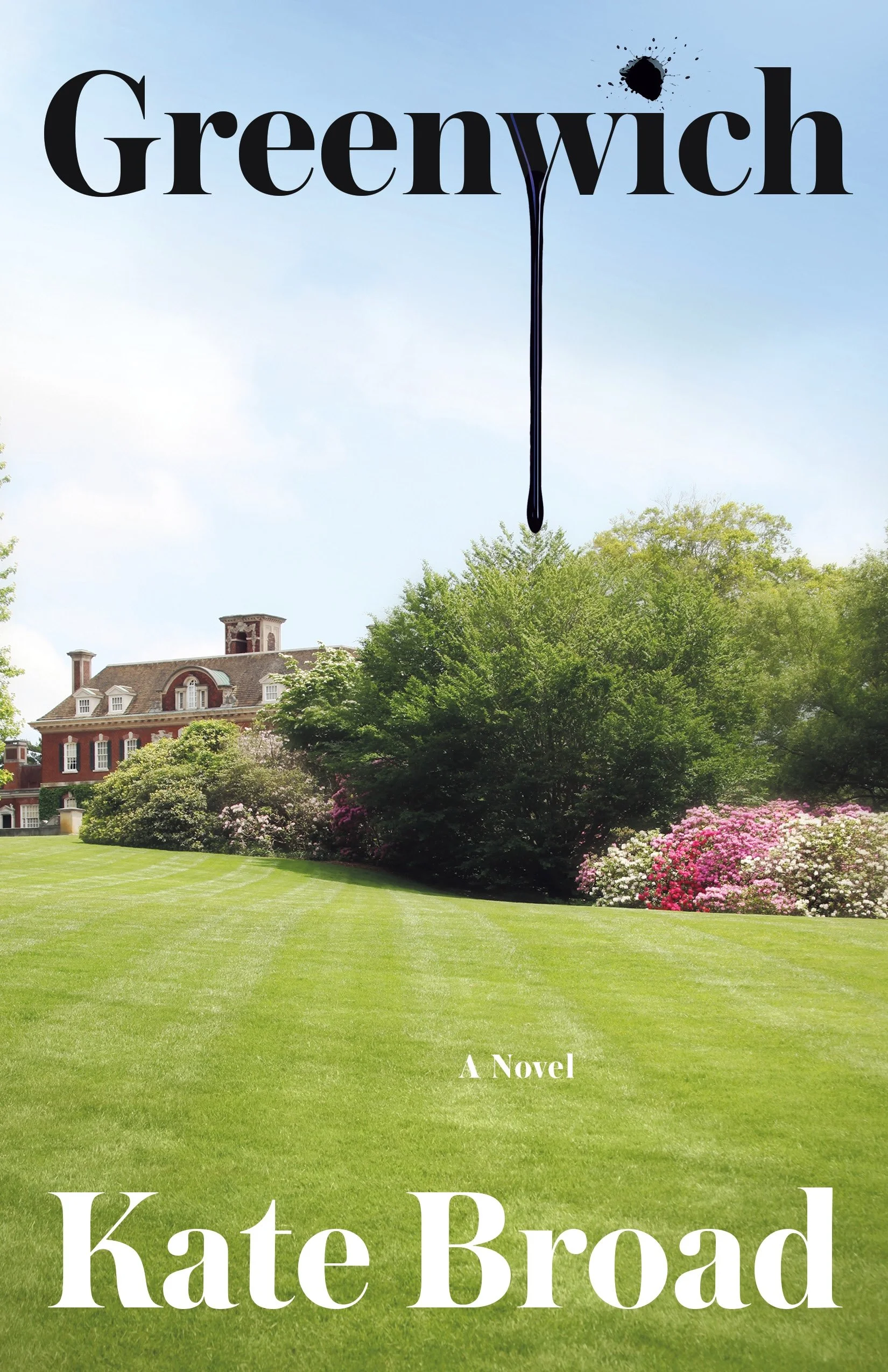
The narrator of Kate Broad’s debut novel, Greenwich, is the sheltered daughter of a comfortably middle-class family who can’t come to grips with how good she has it. Rachel Fiske gets to spend her last summer before college luxuriating at her rich aunt’s sprawling home in the titular Connecticut suburb. She raids her aunt’s secret oxy stash, works her way through her uncle’s wine cellar, and crushes on the nanny, Claudia: all to avoid the sharp edges of life as they reveal themselves. She makes one bad decision after another, and her weak efforts at accepting the consequences read as a sharp rebuke of the way contemporary bourgeois culture often places more value on the appearance of virtue than virtue itself.
Rachel is an avatar for the kind of person that a socially conscious reader should revile. She’s ignorant of the privileges that often come with whiteness and family wealth. She is soothed by the notion that her intentions are pure while those around her suffer for her actions. But even after two reads, I couldn’t hate Rachel, or perhaps I didn’t want to. Kate Broad is tough on her characters. She forces them to reveal themselves, bringing the fullness of their vulnerability to the page. I couldn’t help but see some of myself in Rachel’s bumbling, sometimes tragic attempts to “do good.”
Cliffhanger-style chapter endings, the centrality of psychological dread, and high stakes make for a reading experience that is more suspenseful than the typical literary novel. Greenwich is a character-driven narrative that takes care to portray consequences that ripple far beyond Rachel’s immediate circle. By blending elements from literary and popular genres, Kate Broad has written a page-turner populated by characters that feel, despite their rarefied environs, chillingly average. I wanted to know how Broad thinks about character as a literary concept, along with the choices that shaped her depictions of wealth, privilege, queerness, and racism. This interview was conducted via email and has been lightly edited for clarity.
Christopher Santantasio: Did Rachel’s character come to you all at once?
Kate Broad: I had the basic shape of the story from the beginning: a teenage girl staying with her wealthy aunt and uncle in Greenwich, Connecticut witnesses a tragic accident and has to reckon with her shifting understanding of what happened and her role in it. But it wasn’t until I got deeper into writing that I realized just how far all the characters—not just Rachel—would go to protect themselves, and what the consequences would be. I had to take a closer look at what was actually on the page and let go of any preconceived ideas. I also had to get to know the other characters better.
After I finished the first draft, I wound up rewriting the whole book from third person to first in order to bring the story closer to Rachel. If writing her has taught me anything, it’s to go toward the parts of a narrative that you want to skirt around and to face head-on the parts of your characters you’d rather not see.
CS: There is a line in chapter one that deftly reveals, not only Rachel, but one of the novel’s fundamental propositions: “I wasn’t lying. But not lying isn’t the same as telling what happened. Telling what happened, I’ve learned, doesn’t have to mean telling the truth.”
Rachel is seventeen during the pivotal events in Greenwich, but this line helps the reader understand that the Rachel narrating the action is older. How did you determine when to let the older Rachel reveal something, and how did you know when to let the actions of young Rachel speak for themselves?
KB: Every book teaches the reader how to read it, and right from the beginning Rachel is upfront about the slipperiness of memory, and how “telling the truth” is still only one person’s version of events. I was constantly trying to balance the voice of Rachel as an adult with her foreknowledge and perspective, and Rachel as a teenager, who’s inside the events as they’re unfolding. They’re the same person, but there’s a meaningful shift in perspective. I thought of it like I’d approach any multi-POV scene: Who has the most at stake in any given moment? Who has the most to lose? That’s the voice to lean into.
There are instances in the book where teenage Rachel makes an assertion or an observation that’s biased or just plain wrong, and sometimes I wanted adult Rachel to come in and say, But later on I’d see things differently. Except… would adult Rachel really have that insight? Or was that my own authorial voice pushing into the scene, trying to make sure the reader knew exactly what I wanted them to think? I had to work on trusting myself—and the reader—enough to pull back in those scenes and let Rachel’s be the only voice on the page.
CS: Do you have any insight yet into how readers understand Rachel Fiske? Has anything you’ve heard since the book’s release surprised you?
KB: My favorite surprise has been discovering that I love the word “messy.” I’ve heard it used to describe Rachel and the novel, and it’s so fitting. I think a lot of readers understand her the way you do, where they obviously don’t condone her behavior but get why she does it, and the ways our larger culture and society tend to support people like her and her family. The novel is, as you say, a sharp rebuke, and I guess I’ve also been surprised to find that not every reader sees the critique. Some even think that I’m advocating for Rachel or am unaware of how problematic she is! Yikes.
But that’s the nature of publishing a book: how people read it is out of my hands. Rachel has a long list of literary predecessors who make for compelling narrators, but I think it can still be unexpected to encounter a novel that asks you to read against it, in a way, and maintain a critical eye. No one in the book is put on a pedestal; everyone is trying to protect themselves, and they don’t always consider or care about the costs. It’s been gratifying to hear from readers that the book made them look more closely at themselves and their own lives, and even led them to sit with some uncomfortable truths. I wanted the characters to spark conversation, and they definitely have.
CS: We haven’t yet talked about Claudia Meadows, who is employed as the nanny for Rachel’s young cousin, Sabine. Rachel’s relationship with Claudia is definitely one of the novel’s “messier” elements. Claudia is older, though only by a few years. She is a visual artist from a financially-strapped family. She is Black, and like Rachel, is figuring out her sexual identity. What challenges did you encounter as Claudia’s character developed, and how did you go about confronting these challenges?
KB: I definitely discovered that writing a single POV novel in the first person presents a host of challenges when it comes to crafting secondary characters. Claudia is her own person, with depth and dimension far beyond the narrow slice that Rachel acknowledges. And yet a key part of the book is that we’re only ever in Rachel’s perspective, so I couldn’t jump away from her point of view or describe anything about Claudia without filtering it through Rachel’s limited, biased, adolescent lens. For example, when Rachel’s aunt throws a garden party, Rachel observes how other white people treat Claudia as “the help,” and while she doesn’t make the leap to implicate herself in this dynamic—which would be wildly unrealistic for her, not to mention didactic!—the reader can see what Rachel is both consciously and unconsciously avoiding.
Greenwich is as much about what’s unspoken as what’s on the page, and that goes for sexuality as well. I was a closeted queer kid in New England in the 1990s and didn’t handle my own coming out as gracefully as adult me might have wished for, but the pressure to be “good” and “normal” was so intense. Neither Rachel nor Claudia quite have the vocabulary to name their desires, or the ability to be fully honest with themselves, especially in 1999. I talked earlier about how I changed my whole outline after realizing that their relationship was evolving differently than how I’d imagined. The deeper I got into their characters, the more I saw the ways they’d lash out at each other and hurt each other in the name of self-protection. They both make mistakes—but the consequences of these fumbles are completely disproportionate, as the power imbalance between them becomes more and more consequential.
CS: As a fiction editor at The Rumpus, I had the good fortune to work with you on your short story “Care and Feeding.” What was the editorial process like for Greenwich? Did anything surprise you?
KB: My story at The Rumpus was my first ever short story publication, and I remain so grateful to the journal and to you for giving “Care and Feeding” a home. The editorial process for the story and for Greenwich was surprisingly similar: namely, going through moment by moment and line by line multiple times to make everything as intentional and impactful as possible. I’d worked for a long time on edits to Greenwich with my agent—we’d already done about a year of revising and fine-tuning the manuscript to get it ready for submission. So I’d imagined the editorial process, once it sold, wouldn’t be so in-depth. Now I look back at that confidence and laugh! My editor Claire and I dug into every scene and then every sentence, every word, making sure that every single piece of the novel was doing work and saying exactly what it needed to. I was surprised by how little of the plot itself changed, and yet how fully the book was transformed just by going even more deeply into what was already there. Writing short fiction has helped me play with voice and style and made me more open to taking risks, which I think loosened up my writing in a way that helped bring Rachel’s narration to life.
CS: Part of what makes Rachel an effective character is that you’ve enmeshed her in the plot seamlessly. She simultaneously shapes the events of the novel, and is shaped by them. What choices and ideas led the novel to develop this way?
KB: I didn’t quite realize until recently, now that I’m working on edits to my second book, that I tend to build up character and plot in tandem—each one informing the other to arrive at a structure where the two are inseparable. When I considered the events of Greenwich, I knew what I wanted to have happen, and then I constructed the types of characters who would make those events come to be. Rachel goes to Greenwich and witnesses an accident—but different people would respond differently to those events, so I had to find the meeting point between what happens and who makes it happen. The characters necessarily changed the story, though, as they behaved in unexpected ways and revealed new dimensions of the book to me. Racism, sexism, class anxiety, compulsory heterosexuality, the role of the state and the carceral system—these are all forces that shape the characters’ lives and choices and therefore drive the plot forward. But the narrative hinges on how each individual responds to and defines themselves within and against these constraints.
In every book I read, I’m constantly examining the author’s choices, trying to figure out what they did and why. When drafting Greenwich, I read a lot of books with reminiscent narrators, especially women considering past events about which they feel a sense of guilt or dread; particular touchstones were The Girls by Emma Cline and History of Wolves by Emily Fridlund. For both novels, I mapped out the entire structure—both the mechanics of the plot and the moments of emotional resonance and change—to understand how all the elements of language, story, character, and craft come together. And then I turned that same eye on my own work in order to better see my own choices.
Christopher Santantasio’s (@CRSantantasio) fiction, essays, and criticism appear in Story Magazine, One Story, Pinch, DIAGRAM, Boulevard, The Massachusetts Review and elsewhere in print and online. He edits fiction at The Rumpus and is at work on his first novel. Raised in the Hudson Highlands, he lives in the San Francisco Bay Area with his partner and their dog.
Kate Broad (@Katebroadbooks) is the author of Greenwich (St. Martin’s Press, 2025), which was named one of People Magazine’s Best New Books, a Vanity Fair Summer Read, and an Amazon Editor’s Pick for Best New Literature and Fiction. She is a Pushcart nominee, a Bronx Council on the Arts award winner for fiction, and her writing has appeared in The Rumpus, No Tokens, Electric Literature, Lit Hub, The Brooklyn Review, Bellevue Literary Review, and elsewhere. Kate holds a BA from Wellesley College and a PhD in English from the CUNY Graduate Center. Originally from Massachusetts, she lives in the Bronx.