
Jesi Bender on Her Experimental Novel, Child of Light
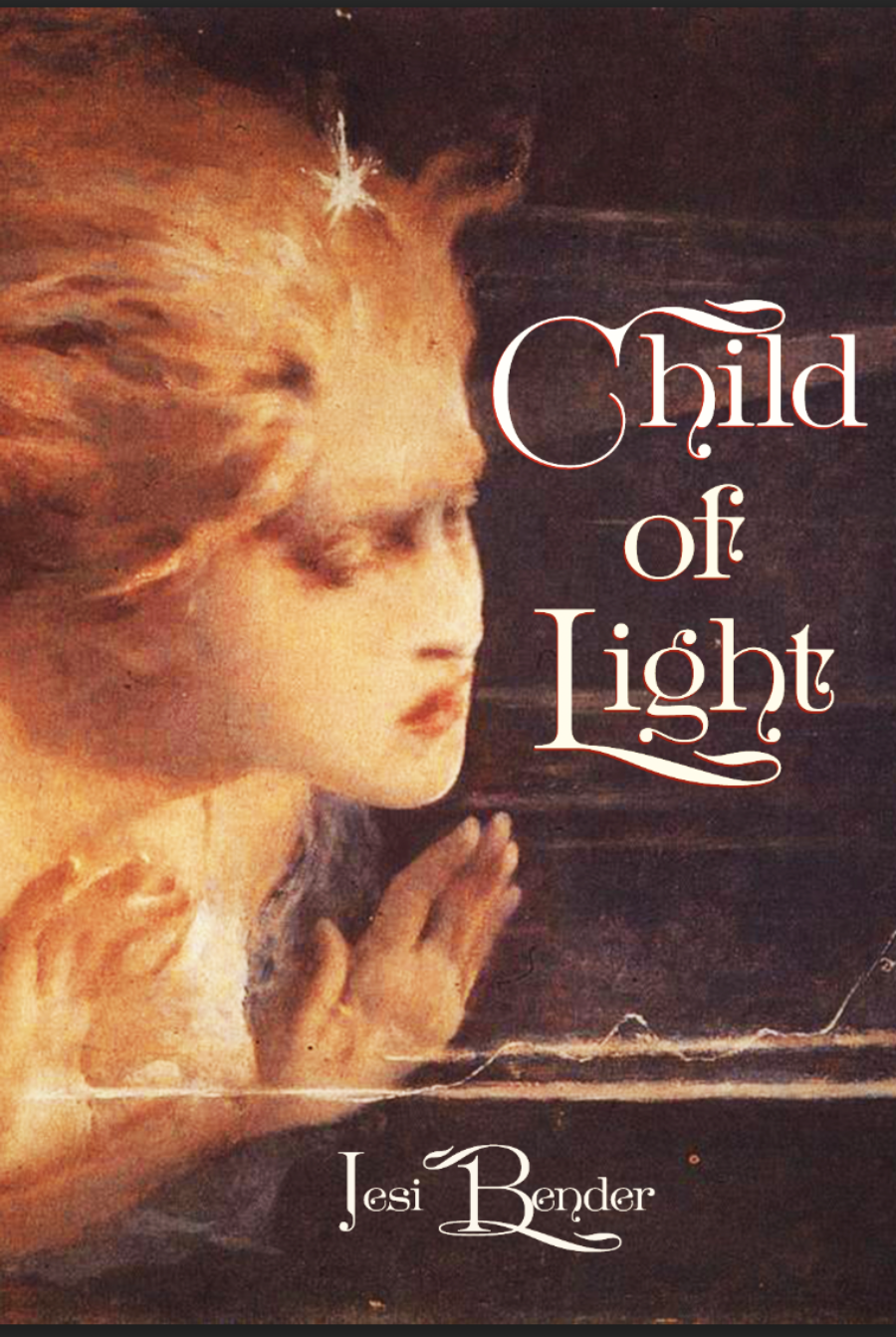
In Jesi Bender’s new experimental novel, Child of Light, nineteenth-century American Spiritualism and the invention of electricity collide, sending shockwaves through the life of young Ambrétte Memenon. Newly arrived in the small but bustling Upstate New York town of Utica, the Memenon family is trying to rebuild their life—Papa through bringing electricity to people’s homes and Maman through Spiritualism—but too many secrets and unfulfilled dreams stand in their way. Now, as Ambrétte stands at the crossroads of childhood and womanhood, a series of increasingly destabilizing events call into question her sense of a woman’s worth, as well as her own reality.
Ahead of the novel’s release, Bender and I discussed these themes in greater detail, as well as the process of writing and researching the novel. I spoke with her via email. This interview has been edited for clarity.
Jennifer Savran Kelly: What initially fascinated you about the relationship between electricity and spirituality, this particular intersection of science and religion?
Jesi Bender: I’ve always been interested in anything that claims to know the unknown or unknowable. I think both religion and science do this, though in different ways. I knew I wanted Child of Light to be a Victorian gothic story and that I was interested in incorporating Spiritualism, so I did some research about what were major scientific advancements at the same time, and I thought electricity paired so well with Spiritualism and the idea of “energies.” I also really loved how mundane domestic lighting seems to a modern audience but how revolutionary it would have been when first introduced.
JSK: The novel is historical fiction set in Utica, New York. What drew you to this time and place?
JB: I have a love affair with Utica. It has art and great food and abounds with history. I also like that it is gritty and isn’t a sterilized “rich person” place. Utica, during the time of this novel, at the cusp of the twentieth century, had a lot of money, which led to a lot of art and architecture and cultural institutions. Important people and movements came through Utica. While the city went through an economic downturn, it’s now on an upswing, which means it’s still affordable for common people but has all the beautiful old buildings and art museums and a wonderful public library. It’s also incredibly diverse—people should check out the documentary Utica: The Last Refuge.
JSK: Ambrétte tends not to use her voice, which ultimately leads to dire consequences. Maman has more of a voice, but it is often silenced. When Ambrétte does try to speak the truth, she’s admonished for being impolite. Can you talk about the role these characters’ voices play—or don’t play?
JB: Ambrétte struggling to “find her voice” or understand her place is the heart of this novel. Like many young people, she struggles with knowing how to effectively communicate, and people older than her are constantly telling her how she should be behaving or thinking. They try to tell her what she should want. This is often at odds with what she actually desires. This is a perennial problem—people often still withhold agency from young women. For me, it’s not that Ambrétte doesn’t use her voice; she doesn’t even understand that it’s possible at this point in her life. The gender dynamics of 1890s New York have their own peculiarities but are alarmingly close to what we experience now.
JSK: In addition to the silencing of voices, there’s a lot of silence in the novel, and there are many secrets in the family: “She [Ambrétte] was just appreciative to be within the radius of her mother’s shadow” and “wanted to explain herself but Maman was already gone, disappeared into the bowels of the Memenon maison.” What roles do silence and invisibility play?
JB: I know in my experience as a young woman, I often was trying to make myself invisible, trying to not draw any attention. Ambrétte, sensing the tension in the house, is trapped in the paradox of silence: In one sense, it’s freedom from scrutiny; on the other hand, it is stifling her ability to really know herself and to assert her place in the world. I also think the sounds in this novel, from the music to the French language-like glossolalia to the large silences, give the Memenon home a haunted air.
JSK: Yes, it does feel haunted. Ambrétte’s father also plays a role in that. He sheds literal light by bringing electricity to people’s homes but fails to shed metaphorical light for Ambrétte. She doesn’t understand much of the French he speaks, and he’s often not around. When he finally tries to establish a real connection with Ambrétte, he fails to understand what’s weighing so heavily on her and therefore fails to correct the misunderstandings that are leading to her breakdown. Can you talk about this?
JB: The father figure is definitely an instance of [too] little, too late. I don’t think he has any ill will toward his daughter, but he’s been so enveloped in his own obsessions (the light, an unfulfilled love affair) that he has barely noticed her. I think this is common in many families, where the children are the mother’s responsibility. The distance of language between Ambrétte and Papa only further isolates her and makes his genius more sacred and mythological.
JSK: Ambrétte is a child, and her childlike perception contributes to this. The experimental nature of the novel—chapters alternating with vignettes, columns of text, dialogue and exposition in untranslated French, grayed-out words—adds to the confused nature of a child’s thoughts. This brought me deeper into her feelings and perceptions. Can you talk about these structural and craft choices?
JB: I’m very interested in representing understanding from a neurodivergent perspective, and to me, the desire to amalgamate all the different ways information comes to us mirrors divergent thinking. This is my attempt at reconciling experience as a way of understanding with the constant stream of information coming at us. We learn through images, through stories and song. We have to distinguish meaning from overlapping voices. I wanted to present different ways of thinking through the form of the text itself.
One of my favorite passages is the “braided” chapter where the stories of Maman’s and Papa’s childhoods are two separate columns. At the point of their meeting, the narratives start to alternate or braid together, and the chapter ends in a single, centered column, where the parents and their narratives are now joined. To me, it reflects how one might visualize the “love story” of their parents.
JSK: This is exactly the feeling I had reading the novel: an (enjoyable, worthwhile!) attempt to reconcile the stream of information and experience. You also don’t shy away from leaving some important moments a bit unclear, so we lose our sense of reality along with Ambrétte. You did a lot of research for this book. Did any of it help you construct these moments?
JB: These moments were less rooted in research and more in my memories as a child. When something felt magical or surreal, often I was misunderstanding [it] or afraid. I was always looking for meaning, trying to find the details that tied it all together, and sometimes, the closer you look, the more abstract everything becomes.
JSK: What was the overall process of research like for this book? How did it inform plot, story, and/or character?
JB: For my work, I usually have a time period or historic movement that I’m interested in. From there, I will do a ton of research. For Child of Light, I wanted to write about fin-de-siècle Upstate New York. I researched five main areas: Victorian electrical engineering, Spiritualism and the Burned-Over District in Upstate New York, local history in Utica, Victorian culture and social mores, and French history in Paris and Quebec. I also spent quite a bit of time finding biographical information on the real-life characters in this book: Lucien Gaulard, Nikola Tesla, Paschal Beverly Randolph, Susan B. Anthony, and Cyrus Teed.
From there, I mapped out an outline for the story and plugged in my notes along the way. Discoveries during research shaped the outline. For example, the people who lived at the house that inspired the Memenon house were, at one point, casket makers and ran that business out of the house. I took that as the business that keeps the Memenons afloat when they first make it to Utica.
JSK: Without giving too much away, Ambrétte’s brother, Georges, does terrible things. Can you talk about the relationship between tragedy/trauma and mental illness—for both Ambrétte and Georges?
JB: This circles back to your first question for me. Religion often gets criticized for trying to answer questions that humans simply can’t answer. But I’m also interested in where science does this, too. Mental health, cognition, epistemology, psychology, and neuroscience—the brain itself is largely unknown, even to this day. The history of mental health is infinitely interesting and, more often than not, horrific. When someone undergoes a horrible trauma, is the resulting mental distress an illness? In other words, is it something to cure, something possible to cure? I don’t have an answer, but I wanted to ask those questions and examine how societies have handled violence or difference and how they’ve claimed to understand the internal workings of a mind.
JSK: Repressed homosexuality plays a role in Ambrétte’s parents’ marital and family issues. What role did that play for you in the novel? And in Georges’s anger at women, if any?
JB: The fact that all homosexual acts in this book are unnamed and hidden from view means that the very idea of same-sex relationships is unrealized in Ambrétte’s mind. The possibility of being gay is completely undefined and, in several instances, Ambrétte confuses same-sex love with acts of violence or illness. It does not occur to her that this is an option, even if she intrinsically is attracted to another girl.
It relates to her brother, misogynist Georges, because repressing homosexuality is another means of control. Narrow definitions of appropriate relationships are the same as narrow definitions of appropriate roles of women in Georges’s perception of ideal social mores. Georges wants everyone to act a certain way and to fall within specific gender lines, and when they don’t, he’s incensed. Maman and Papa’s sorrows mainly stem from a yearning for some meaningful connection, one which they paradoxically denied themselves by attempting to form one with each other.
JSK: Ambrétte has a forbidden friendship with Celeste. Can you tell us about that character and her role in the story?
JB: I think we tend to be attracted to either our reflections or our opposites. For Ambrétte, Celeste is her opposite: she’s poor, she’s mixed race, she’s confident, and Celeste very much knows what’s important to her and what she wants. It was important to have a counterweight for Ambrétte’s family: someone she could rely on and someone who shows her unconditional love. It is the experience of Celeste’s acceptance that opens up Ambrétte to the idea of life outside her family. It is a pivotal point in every child’s life—to learn that their family is not a reflection of the rest of the world. I thought it was important for Ambrétte to experience that and to have some hope in a book that deals with a lot of difficult subjects.
JSK: What was the most fulfilling thing about writing this book?
JB: It is very cathartic to write about the past as a tool for examining life today. There is an odd comfort in its distance but also in that everything seems “solvable” in retrospect. Some might find it depressing that problems cycle and persist across history, but I find some hope in thinking that we can find the patterns there and make small but significant moves toward unknotting our miseries.
Jennifer Savran Kelly’s (she/they) (@savranly) debut novel Endpapers was a 2024 Lambda Literary Award finalist and a fall/winter 2023 Indies Introduce pick. Jen’s short work has appeared in Short Story, Long, Potomac Review, Black Warrior Review, Trampset, Green Mountains Review, and elsewhere. They’ve published interviews and essays in The Rumpus, Crime Reads, and The Millions, among other places. More at jennifersavrankelly.com.
Jesi Bender (@jesi.bender) is an artist from Upstate New York. She is the author of the novels Child of Light and The Book of the Last Word, the plays Crux (forthcoming) and Kinderkrankenhaus, and the poetry collection Dangerous Women. Her shorter work has appeared in Denver Quarterly, FENCE, and Sleepingfish, among others. More at jesibender.com.