
The Shape of Joy in the Shadow of Grief: On Summer Farah’s The Hungering Years
Joy is a Thing & Yes We Can Feel It
Around the time I spoke with Summer Farah about her debut poetry collection, The Hungering Years, I was returning from what I lovingly referred to as a Big Fat Palestinian Wedding (BFPW) in California. It was a no-holds-barred, multi-day traditional wedding, and I won’t soon forget the feeling of having people my father once saw daily and now hadn’t seen for years draping me in a borrowed thobe at the ziyaneh, passing me a keffiyeh to wave during the zaffa, showing me that characteristic way all Arab women dance—like they have a secret is how my Teta once described it.
For weeks after, I thought of how surreal it felt when the shape of collective joy was more legible than the shadow of collective grief. (And why did this feel surreal?) Joy is not simple, of course. Did conversation sometimes drift to discuss anger? Yes, we touched on this a little. Trauma? Yes, my father told me a story he’d never told me before, about that time when he was a child and he was warned to never pick up any discarded items in the street because Israel was planting bombs again. Prayer? Yes, we touched on this a lot—whom we prayed for; how often we prayed; the ways we doubted prayer. But momentarily I was reminded of the restorative power of kin, the immediacy of family amongst a diasporic people, and the rare beauty that comes with being in a space that allows humans to perform the fullness of their humanity: an allowance increasingly denied for Palestinians as Israel’s genocidal war on Gaza continues.
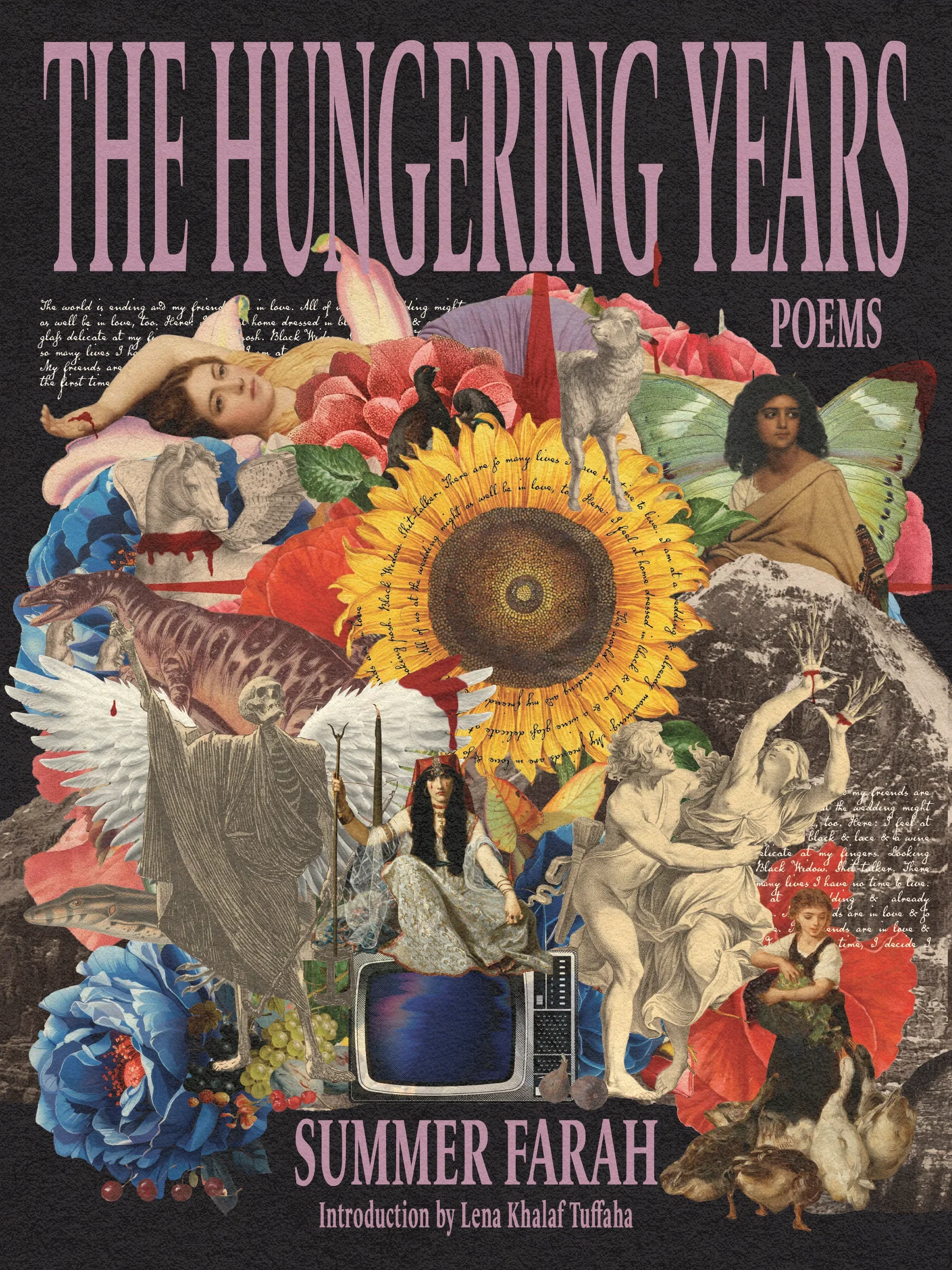
In The Hungering Years, Summer Farah is concerned with hunger. And not just the fact that we are hungry, or how quickly and constantly the shape of that hunger transmutes into something we can barely contain in its multiplicity. (“I want to know what lies at the bottom / consider, the abyss: a reset point,” she writes in “Interlude: Parallel Playing W/U,” and “I want to be cruel. / I want to know less. / I want to look away,” she writes in “On New Year’s Eve We Make Kebab”). But also the ways we tend to this hunger—in writing, in kinship, in fandom, and in joy.
I think the reason I was thinking of my BFPW in relation to her debut is because of the way Farah, also, is concerned with play. With companionship. And with the ways in which the complications of joy—not just anger or grief—can make one attentive to the world. When I spoke to Farah over the phone and I told her I was surprised by how funny the book is—thinking of one poem in particular, “I Tell Etel Adnan About My Pussy Problems”—Farah laughed and said, simply: “I love to make people laugh.” I wondered fleetingly why I was so surprised that grief and joy could coexist in a text and if this betrayed an underlying complex whereby I doubted grief and joy could healthily coexist in life. There’s a lot to grieve, after all, and sometimes this makes joy feel tricky. Farah explores a lot of sources of grief in The Hungering Years: settlers torching Palestinian homes; flowers dying despite our efforts to care for them; the way “everything leads back to empire—that container in which our bones rattle, cracks widen when voices climb that awful awful ladder.” And the sad fact that “the world has always been ending.”
But the power of grief should not belittle the power of joy. And joy can exist not just as a sensation but as a force towards creation.
“Poem for Akka Before Settlers Torch Palestinian Homes, May 2021,” is a poem Farah describes as beginning with a prompt from a Claire Schwartz workshop, which asked poets to write about joy. The proceeding erasure that accompanies “Poem for Akka…” takes up the second part of the prompt: complicate that joy.
“i know i was happy once,” Farah writes, “there is / a photograph to / prove it… / in akka / i sang / to the sea; seven years / old & my first love / the mediterranean breeze.” And while joy is memory and proof of change here, it’s also a place to excavate longing. When Farah returns to this poem in its erasure, she writes, “the air / was happy / once… akka / sang / the sea…”
I love these sites of complication because they ask us to not just consider the force of erasure but to imagine a Palestine deeply connected to our sense of joy. That’s a subversive consideration that shouldn’t be subversive. The same way going to a Palestinian wedding to dance and sing about dancing shouldn’t feel surreal. All of this is, partly, to say: The distinction between love and joy, lately, seems so inscrutable to me.
I feel this when I feel Farah’s lines: “Anything is worth the laughter, the love, this chorus of joy… If only, if only, the universe held enough balance to allow me to exist in the same place as those whose hearts matched mine for longer than a week. Of course, who can know you completely before you are fully yourself?”
2. On Fandom & The Archive of Influence & The Dream-Logic of Accumulation
I asked Farah where her poetic impulses first came from, and we started talking about fandom. “I wasn’t on poetry Tumblr [in high school],” she said, “but I was on fandom Tumblr in which poetry is used and juxtaposed alongside images of your favorite guys. I think that that was a really interesting way into poetry as this sort of comparative practice of reference.”
The traces of fandom run like a spine throughout The Hungering Years: The Legend of Zelda and Supernatural; Mary Oliver and Mitski; Portrait of a Lady on Fire and Olivia Rodrigo; Carly Rae Jepsen and Etel Adnan (who National Book Award-winning author Lena Khalaf Tuffaha calls Farah’s muse in The Hungering Years’ introduction). The architecture—or archive?—of influence is so eclectic, you get what I mean when I say this collection is as playful as it is powerful and probing.
“Who will love me in these shortened moments of dusk?” Farah asks in “I Tell Etel Adnan About My Pussy Problems.”
And in “(Dear Etel Adnan) I Don’t Think of Carly Rae Jepsen)”: “This must be exhilaration / to steal a thesis from a terrible man: Carly Rae Jepsen thrives in the precipice—wouldn’t you like to dance in your room to the beat of a poem you’ve nearly figured out?”
And in “I Tell Etel Adnan About Mitski”: “All night, I watch my father breathe in an emergency room hallway; to the tune of the woman moaning from a gurney: // I do not want to die here, I do not want to die here.”
Each encounter with the playful—the pussy problems and Carly Rae Jepsen and Mitski—gives way to the existential. What does it mean to live within the wound of an “almost?” What is our responsibility to witness and what wounds heal when we are offered witness in return? Farah sometimes wants answers and sometimes doesn’t. This in itself lends to a dream-like state of possibility.
After talking with Farah, I went down a protracted rabbit hole investigating fandom. Not so much because it’s crucial to consider when considering The Hungering Years, but because I found I hadn’t been an abiding fandom-fan in years and I was trying to figure out why.
What I can say now is that to ask questions of fandom is really to ask questions of devotion in a world where apathy feels increasingly accessible, inevitable, and even self-protecting. In The Hungering Years, fandom feels like an expression of care, and dare I say an extension of humanness? At least insomuch that we all desire connection. And isn’t this what fandom is about? Beyond the fact that Farah’s fan-based poems are cool, they’re also evidence of yearning, of the desire to be among. To not write “of,” something but “to,” and maybe even “with.” Just as I found restoration at my BFPW, Farah explores the revelatory possibility of communing with those she has adored.
A snippet of our conversation on this:
ADLA: Thinking of poetry in reference, there are so many references wound throughout The Hungering Years. A lot of the time, you’re also speaking directly to some of these sources. Have you ever had a moment where you imagined what some of these influences you’re addressing might say back to you?
SF: You know, it’s funny. Earlier, my publisher was finalizing details for my launch in Austin. And she was like, “Do you want me to try to invite Jared Padalecki?” And I just said, “No, absolutely not.” Not to say that he is, at any point, anyone I’m addressing in this book. He’s not… but I do have this deep anxiety about this sort of disapproval of those I interpret, or those I write after, or those I live after. And so I have had nightmares where Simone Fattal [Etel Adnan’s partner] emails me and is like, Girl, shhhh—stop this. But I think on the other level, a lot of this book is searching for companionship. And so often in my life, companionship has meant people who are very far away or people who cannot speak back to me. And so to imagine someone answering is sort of beyond the comprehension of the book.
ADLA: With all of those Supernatural poems and the Mitski poems and the Etel Adnan poems—I have to ask: Do you think Etel Adnan would be a Mitski fan?
SF: Okay, I’ve been thinking about this really hard. She writes a lot about visual art. It gives me a sort of understanding of her tastes. I could not recall a time she’s talked about music. But I can extrapolate based on the visual art. There are Mitski songs she would be into: “Valentine, Texas” for the weirdness and the eeriness. I think she would like “Come Into the Water,” because of the sort of questioning of [a] masculine attachment to a muse—which feels very in line with Of Cities, and Women. She has this writing about love and how overwhelmingly destructive it is. And I think that because of this, she would enjoy the kind of too-muchness that Mitski writes about in “First Love/Late Spring.” The allegorizing that Mitski does of love as labor is also something Etel would be interested in. So I would make her a playlist.
Many times, it has felt to me like one condition of being Palestinian involves considering distance and how collapsible and expansive this can feel at once. Distance from history—which is always history for one person and an ongoing present for someone else. Distance from home(land). Distance from belonging or understanding. Farah pinpoints another version of this in her thinking about what it means to write after someone: what it means to enforce both companionship and distance between you and your influences. In “After We Watch Roadfood I Consider Place,” Farah writes:
“Etel, you wrote about wanting a place: Berkeley / Damascus / Delphi / Beirut. I understand the cling to the ancestral, as if my latent spirituality means there is something waiting for me in Nazareth. You know, Anthony Bourdain has seen more of Palestine than I have…”
Once, I took an Arabic class filled with a bunch of non-Arabs. And I remember getting really pissed that a lot of them were better at Arabic than me. Many had done study abroad programs in Jerusalem. Built schools in Rafah. Eaten fresh knafeh in Nablus; torn into a Jaffa orange straight from the branch. My irritation was selfish—I should have been proud of the growing interest in Arabic language because it might hint at a growing interest in Arab culture. Instead, I was just mad that people outside of my culture were mastering some piece of it with more skill than me. I wanted to go around shouting: I know this place better than you! simply because I knew this place in my blood, in my inheritance. What I meant was: I know this place differently. I was frustrated that difference felt enforced on me. My rules of engagement with the land were a more tangled web of complication.
Relatedly: Farah and I talked about a restlessness we both felt. The difficulty of defining home, of feeling home, and the uneasy guilt that comes with wondering if you’ve defined it too simply. This could be diasporic inheritance, a real-time expression of the wounds of ancestral exile. Home/place/refuge is a loaded noun for any Palestinian and its shifting iterations a testament to both violence endured and resilience cultivated. We can make a home anywhere, is how my Teta once described it.
But Farah extracts such a sense of powerful possibility in not just defining home but defining it over and over:
“I imagine the fig trees my mother used to scale. I imagine a Mediterranean sun…A home disappears around us & I wonder what will happen to the lemon tree by the window…”
And:
“I could be elsewhere, / always on loving earth sidled next to stone. / This is home, maybe, home, / Maybe these streets are the ones I know best: / vibrating with my anxious history.”
And:
“Leena & I pass notes during a craft talk on home: she tells me, liberation means my return, too. Etel, I am as at home in Oakland as I am in Seattle as I am on an airplane… as long as someone is speaking to me.”
The homes in The Hungering Years accumulate as frequently as the recipients of fandom. They lead to a kind of dream-logic of accumulation and associative leap. Some things feel lost, missed, and grieved, yes, but also archived, felt, and stored.
Is to feel at home away from a homeland a betrayal? Can we encounter home through her descendants? Can we set aside a consideration of home, just for a minute, and also think about love songs and memes and movies and plane rides and birds and which noises they make and which ones they don’t? All of these are questions in The Hungering Years, and the poem as speculative practice also feels a great deal a part of the project Farah takes on where the big-sad-stuff (Farah has called herself an “Arab American poet sad girl”) must see our witness alongside the big-beautiful-stuff because this is, so often, what it means to survive.
3. Defining a Mountain or: The Mitski-Etel Intersect
One morning not long ago, I opened my laptop to find an internet query I’d conducted the night before and forgotten: “Define: mountain.” I’m not sure why I was asking or what I was looking for. I found it funny I distrusted my own innate sense of the world so much that a mountain was a thing I needed to define. Isn’t a mountain just a mountain? Vast and unmoving and sometimes beautiful and sometimes scary?
Summer Farah’s two muses, Etel Adnan and Mitski, have things to say about mountains.
In “Valentine, Texas,” Mitski sings: “Where clouds look like mountains, clouds look like mountains. Let me watch those mountains from underneath, and maybe they’ll finally float off of me.”
And of the many things Etel Adnan has said about mountains, one thing is: “In this unending universe [Mount] Tamalpais is a miraculous thing, the miracle of matter itself: something we can single out, the pyramid of our own identity... Our identity is the series of the mountain’s becomings, our peace is its stubborn existence.”
And so maybe a mountain is not so definitive. Maybe a mountain is quite like the series of projects in The Hungering Years: the certainty of shift and endurance. The “miracles of matter,” as Adnan would say—the vast assemblage of things we have been changed by. The blurry way the singularity of revelation and the multiplicity of meaning around us ebb and flow so often—like clouds and mountains.
Summer Farah has things to say about mountains too: “The mountain was there before us and it will be there after.” The mercy of continuity. The painful grace of being outlasted and of trying, again and again, to make our own beautiful mark. And just one more, while I have you: “Language can feel so lush. This eeriness will always remind me of mountains, phrases that sound like clouds cover their peaks… We must find a way to go forward.”
Before Farah and I spoke, I realized both our fathers are from Nazareth, Palestine. This felt like a kismet reinforcement of one of The Hungering Years’ most compelling raised possibilities: We’re never quite as far from the people we love as we think we are. Whether history, empire, time, or miles of land try to assert a distance, that distance can give way when met with the resilience of a people who know how to rebuild.
In the final poem of The Hungering Years, Farah writes: “...in nazareth there is a church my father’s greatmaybegreatgreatgreat / grandfather rebuilt after it burned /… the colonizers’ history cares nothing for our fingerprints / how long are memories anyway?” I find a great deal of power in the question “how long are memories anyway?” because, at this point, Farah has proven they’re really quite long. And made longer still by those who tend to them. Like Farah. Like the guests at a wedding, standing up to dance and sing “Ana Dammi Falastini,” through an otherwise quiet California street.
When I went to that wedding, I danced so much, felt so much, I thought I might weep. This was one way “to go forward.” To tell you that is to tell you everything.
A.D. Lauren-Abunassar (@lauren.abunassar) is a Palestinian American writer, poet, and journalist. Her work has appeared in POETRY, Narrative, Rattle, Prairie Schooner, Boulevard, and elsewhere. Her first book, Coriolis, was winner of the 2023 Etel Adnan Poetry Prize. She is a 2025 NEA fellow in poetry.
Summer Farah (@bordersbookstore) is a Palestinian American writer, editor, and zine-maker from California. Her chapbook I could die today and live again (Game Over Books) was featured in Electric Literature’s “Favorite Poetry Collections of 2024.” Her work has been nominated for Best New Poets, the Pushcart Prize, a Hugo Award, and is anthologized in Heaven Looks Like Us. She is a member of the National Book Critics Circle and the Radius of Arab American Writers. The Hungering Years is her debut poetry collection. She is calling on you to recommit yourself to the liberation of the Palestinian people each day.