The Writer’s Residency—Detoxifying Amidst Birch Trees: an interview with Marjee Chmiel by Jack Barrie
I had the chance to sit down with fellow Split Lip flash fiction reader Marjee Chmiel to talk about her recent month-long stint at Arteles, a silent artist’s residency in rural Finland. She and I had just peer-reviewed each other’s short stories, and both stories were published not long after. From that brief share of work, I got a taste of Marjee as a writer and wanted to know more. Our interview, which we conducted over Zoom, ended up being a fascinating window into residencies, writing habits, and Marjee’s world as a creative.
In addition to reading flash fiction for Split Lip, Marjee has just stepped into the role of Co-Director of Social Media for the magazine. She is a writer, researcher, and education and media creator working to advance the understanding and care for people and nature through storytelling. She has produced award-winning stories in a wide range of formats including video games, documentary film, comics, animated series, articles, and essays. You can find her work at www.marjee.org, and I encourage you to read her vivid story, “Norwood Park Novena,” which landed in Maudlin House this year.
Note that this interview has been edited for length and clarity.
Jack Barrie: So, Marjee, you’ve just returned from Finland, from a silent writer's residency. Before we get into what that looked like, could you tell me what your experience was like discovering this residency and how it compares to others you’ve attended?
Margee Chmiel: Yeah, the only other time I’ve done anything like this has really been writing residencies where we have workshops in the morning, so it does feel totally different. Those are in the United States and there’s always a big social component including drinks and karaoke and it goes by a lot faster, whereas this was incredibly meditative. It’s a long period of time and you’re very far away from home and I felt like I was eating so healthy and being so healthy that my body was telling me “you really need fried food to continue on because there’s just too much healthiness.” I was like, “I’m going to break down and buy candy.” But Finnish candy is not, uh… Finns really love salty liquorice, which doesn’t scratch the itch that I had.
And as far as how this all came about to me, it was one of those things where I just started putting the application together, like I dropped everything and put it together. There was something deep in me. I mean I’m very conscious of what my cognitive diet looks like. Like, the contact that we have with social media, the infiltration of AI slop, all of that is concerning to me, in terms of what that means for my imagination and where I want my storytelling to go. And it’s something that I feel is only going to get harder to preserve, that fingerprint that makes us good at what we do with writing, right? So, I really wanted to know who I was without all of that stuff. And as for where I was professionally, I was really, really burnt out. Everything was screaming for me to give this a go.
JB: Grand. So, you used the word “meditative.” Could you talk about the sort of routine and the environment of this residency and what that looked like?
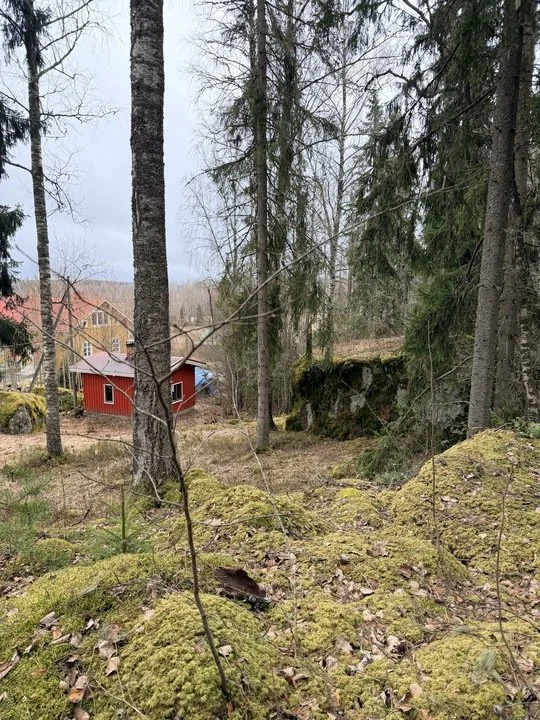
MC: Yeah, it was on the property of an old school in rural Finland about an hour outside of Tampere, which I think is the second largest city in Finland. It was pretty out there, kind of set off in the woods on a sort of country road.
There were about eleven of us. One of the things that was really fantastic for me was that this was the first time I’d been in any sort of a residency where it’s not just writers. There were a lot of visual artists and people working across different mediums. One of the people was a musician. It was really interesting to all of us that a musician opted into a silent retreat. So, people were coming from a variety of backgrounds, and we had our own rooms, shared bathrooms, and a shared kitchen, which was kind of the most stressful part of it for me. But the routine was that we had no talking prior to 10am every morning and totally silent weekends. And then there was half an hour meditation every morning and every night. And of course it’s Finland, so we had sauna every other night, which was absolutely incredible. I realized now, coming back to the States, and I knew this was going to happen, that I feel like everything is so noisy. At that time of year [February] in Finland, everything really is silent. Like there are no birds, you know what I mean? So the nature itself is silent.
JB: Wow. That is so cool. So, were there allotted times where you are on your own in that environment, where you were confined to a space or were you just roaming? What was your average day like in terms of sitting down and writing?
MC: There was a studio space that was shared, and I sort of learned that that was where I liked to be when I was doing revision and editing work, having my chair and my desk overlooking the forest and the lake, and peeking in and seeing what my neighbours were working on from time to time. But then I found out very quickly that when it came to starting new stories, so brand new drafts, I really did like to be in my room.
But I think that the other thing that having that much time to work strictly on writing and nothing else also taught me is just what a physical act it is. And how important it was to make sure that I would go walk in the forest before it started to rain or go do yoga because I’ve been sitting in a single position for three hours. So yeah, it was really interesting to be in a situation where you can be that attentive to mind and body, and nothing else.
JB: You mentioned the forest and it being such a unique location and being in this space with these creatives, in silence; did you learn anything about your relationship with “place” in writing?
MC: Yeah, I mean, I think place is instrumental to the work that I’m doing anyway. I write a lot about the hometown that I grew up in in Chicago. It’s a really important part of my writing. And being in Finland, yes. The other thing about being in a place with a group of artists is that everyone is very open with their kind of woo-woo, which I think is necessary for artists. I discovered that I was sleeping very deeply and having wild dreams, and that was something that we were all experiencing. And for me in particular, I think because we were at an old school, I feel like my subconscious was excavating a lot of things that pertained to growing up and thinking about things, people, relationship, formative experiences that I hadn’t thought about in decades. So, to that extent, I feel like being in an old elementary school was really powerful.
And then one of the women who was there had also pointed out that we were among a lot of birch trees, and birch trees are known as these detoxifying plants. So, we extended that to this idea of potentially detoxifying our subconscious because we were all sharing that experience. And of course, sweating it out in the sauna, which also was a great way to sleep deeply and have these profound nocturnal revelations. The hard thing for me is to try to figure out how to bottle that up and bring it with me. And I haven’t figured that out.
JB: Yeah, wouldn’t that be nice? On that point, earlier you mentioned cognitive diet. Was there any enforcement on device usage or anything like that?
MC: There was no Wi-Fi. If you needed the internet, you had an hour that you could sign up for a day, and during the weekends it was discouraged. This residency, Arteles, for their summers, they do “back to basics” where your devices are confiscated. We had one woman in our group who had done that the previous summer and she had loved it. I wasn’t sure how I was going to feel doing this. I was anxious about it on the way into it, but I really did like it and I’m at a place where I would love to try the device-free experience at some point as well.
JB: Totally. You touched on my next question there. I know personally for me, I love the idea of writing at a lovely little wooden writing desk, a window looking over an amazing vista, but I always find that I care more about the vista than my laptop and I’m like, okay, I need to be in a sort of Russian brutalist cell or something, you know? Did you encounter any sort of resistance internally or creatively being in this new environment?
MC: I constantly struggle with creative resistance. So, I think the short answer is yes, but the longer answer is, you watch the days kind of melt away, and it quickly becomes apparent how much just the work of being a human being takes up your time. I would certainly have word number goals in mind or this much of the story or this much of the scene. And I never met any of those because, you know, you would sit down, you would work, and now you’re really hungry, right? And so now you have to cook a meal, you have to clean up after yourself, all of that kind of thing.
I do feel like that was always nipping at my heels, that you were really watching time disappear. Next thing you know, it’s another sauna day, and now you’ve only got three weekends left of silence, two weekends left of silence.
JB: Right, off the back of resistance, is there anything that you as a writer have come to expect in terms of your patterns of resistance, that were maybe easier or harder in this silent residency environment?
MC: I do think that one of the things that was easier is being surrounded with other people working on things and hearing them talk about their own frustrations and efforts and seeing what they did to get back into the groove. The ethos of Arteles was low pressure. I mean the reason that they started it is because they have this strong belief in the fact that creativity doesn’t come on a clock. There was no expectation, you know, there was no accountability. There were some people who were there just trying to figure out what was next for them in life, so people were coming at it from a variety of ways.
I do feel like I had a kinship with the woman who was across the hall from me. She was a visual artist from Taiwan and a really hard worker, and she was very like, “oh, you're working hard too.” We were showing up at our desk at the same time, and the fact that we were pushing through it was probably what kept me on task.
JB: And what were you working on in those weekends of silence? What have you returned to real life with, writing wise?
MC: Well, probably too many things. I have that novel that I’ve been working on for like four years. Part of the thought that I had going into the residency is that I would be doing a major revision of it. I think I was surprised by how major that revision was. I feel like I undid a lot of things at the residency as opposed to doing them. The same is true for a short story that I was meaning to revise. I ended up undoing quite a bit of that. And then I did get one story that I’d been meaning to start on the ground and made some serious traction with that. Coming back has been me sifting through the mess that I made of pieces that I thought would be further in progress. But, ultimately, I think it was a good thing. I think that I was able to get an idea of what I was really trying to say with these different stories.
JB: How realistic do you think it is today for people looking to create a routine for themselves and maintain a creative practice that requires an astute attention span, when that is something that is under target by social media?
MC: I mean, my more optimistic self (and I don’t know that she’s often right) does feel like people are getting fed up and disenchanted with the relationship that we’ve had with technology. From a very young age I was always very tech forward and sort of tech optimistic.
I think the problem more recently has been the money side of it, right? The greed side of it, the maximising, everything for the greediest, like shittiest possible reasons. I do get the sense that smart people, creative people are getting tired of it. I recently interviewed an author with several books out, and she’s just off of Instagram completely. I know other authors who don’t do any streaming, don’t watch television, so I see people making these conscious decisions about how to get off of that. I do know from people, particularly my age who have kids in their early teens, that there is a sort of fashion and a fascination with older tech, the kind of tech that wasn’t wired into Elon Musk’s pocketbook or whatever. The tech bosses are doing everything they possibly can to alienate us from tech, and maybe that’s a good thing.
JB: I wonder whether something like your residency is achievable on home soil, without the structure of a retreat. What from the residency would you go about enacting in your day to day and how doable would you say that is?
MC: Yeah, that’s a great question. I’m trying to integrate it slowly. The first thing has been the attention to physicality and being very deliberate about making sure that that time is built into a writing day. So, whether that is yoga or going for a bike ride or lifting weights or whatever. And that’s been relatively easy to incorporate. I’ve also really been trying to stick to a practice of morning pages, which has been easy enough. I’d love to do meditation first thing in the morning like I did there, and honestly, I’d love to be silent too. But that’s a lot harder because I have a spouse who I don’t want to ignore in the morning. And I have dogs who have demands in the morning that don’t necessarily take meditation into account. The easier thing has been scheduling the blocks of time.
The other thing too is that I’m trying to be mindful of the importance of nature.
It’s not as easy as just tumbling out of my bed and getting lost in a massive mossy forest where there’s overturned trees that according to Finnish folklore are portals to the underworld, you know what I mean? I have a bike path. And there’s plastic bottles that I’ll pick up in there, that kind of thing. It is hard, but it’s something I try to return to every day.
--
Jack Barrie (he/him) (@jackstrynawrite) grew up in a forgotten place in the English East-Midlands. His writing has won two Royal Television Society awards, was nominated for Best of the Net 2026, and is published or forthcoming in Split Lip Magazine (where he’s now a flash reader), The New Flash Fiction Review, Blood Pudding Magazine, NUNUM, and others. He pays rent right now by gardening. Find him at www.jlbarrie.com.