
70 Miles in 7 Hours: An Interview with Jack Barrie by Ethan Lam
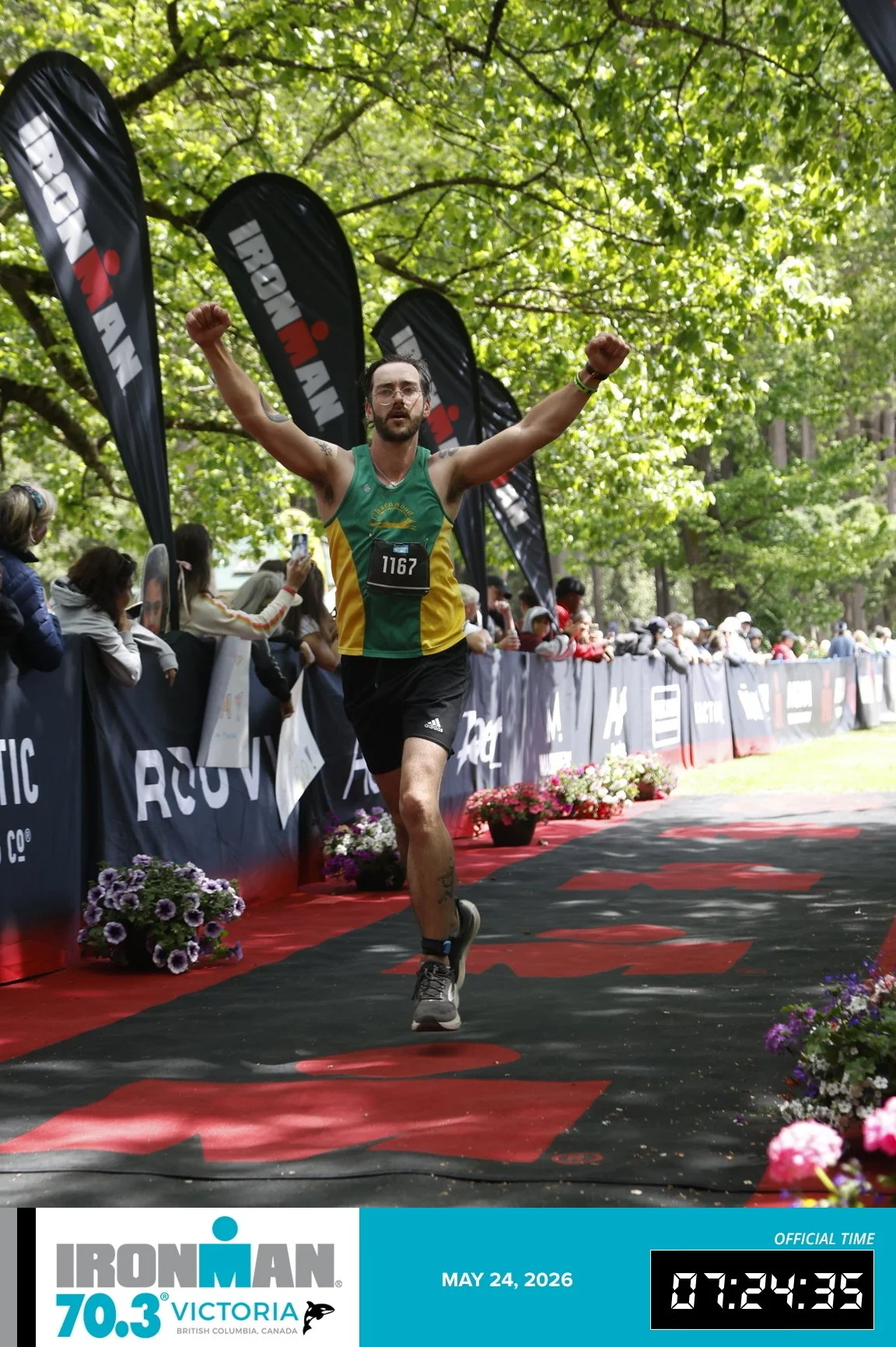
The thought of swimming 1.2 miles, biking another 56 miles, and running 13.1 miles on the same day would intimidate anyone. Yet, that is just what the IRONMAN 70.3 demands from those who dare to attempt the half-distance triathlon. On May 24, Split Lip Magazine’s very own flash fiction reader, Jack Barrie, completed the IRONMAN 70.3 in Victoria, British Columbia, Canada, with an official time of 7 hours, 24 minutes, and 35 seconds. The entire staff at Split Lip was ecstatic—the magazine’s Slack channel was exploding with messages congratulating him on his incredible feat!
Jack Barrie grew up in the English East Midlands. His writing has won two Royal Television Society awards, was nominated for Best of the Net 2026, and is published or forthcoming in Split Lip Magazine, The New Flash Fiction Review, Blood Pudding Magazine, NUNUM, and others. Find him at jlbarrie.com.
I interviewed Jack over email, and here’s what he had to say about balancing athletics and writing.
Ethan Lam: Congratulations on completing the IRONMAN 70.3! How did you train for it, and what did your regimen look like? How intense was your training? How did you prepare both physically and mentally?
Jack Barrie: Thanks, Ethan. My training partner Mackenzie and I started off thinking we were already most of the way there physically and mentally. We absolutely were not. We dove into the deep end, pushing ourselves as hard as we could very quickly. We ran a half-marathon the day after my first-ever Thanksgiving (as a British immigrant to Canada), and that ended with both of us weeping and shivering on the living room carpet, begging for leftovers. Coupled with our inability to swim more than two laps of a pool without passing away, this experience kicked us into gear, and we started training the proper way, three or four times a week. That was November, and we only really felt ready for the distances around the middle of May, particularly with the swim; our teacher (shoutout Saskiasays) really made the difference there. I didn’t realise how much technique goes into each of these sports, and how little we had a grasp of.
EL: Which part of the half-distance triathlon was the most challenging? How would you rate your performance during the event?
JB: The run was by far the hardest, which is what we trained the least, which was dumb looking back. I was already a regular runner, so I focused on the bike and swim, of which I had basically no experience, and as a result, I smashed my PBs for both of those legs on the day. Of everything, though, the secret boss battle was the nutrition. We thought Thanksgiving dinner and fibre bars would be good for it. Seemed right. There couldn’t be much worse things to eat for those exercises. Luckily for me, my race partner Mac did a lot of research as to what we should be consuming, how much, and at what point. Getting your body ready to consume thousands of calories on the move was something I didn’t realise would be such a taxing element.
EL: What were the personal stakes of competing in the Ironman 70.3?
JB: I competed with a few things in mind. First, I’m approaching thirty this year, and as little as that really matters, I’ve set a level of fitness that I want to maintain for this coming decade of my life, and I thought this would be a great bar to start. And it was a good excuse to see more of the amazing place that is Vancouver Island before my working holiday visa runs out via trail running, long-distance cycling and open-water swimming. It is, naturally, such an incredible part of the world. More importantly, though, I had my buddy Ethan Walsh in mind. He was a childhood friend, and he passed away a year or so ago. He was the fittest guy I’ve ever known; we used to pole vault for Charnwood together. He was a champion, and I had his voice in my head every time I would push myself past my exhaustion threshold. I could see him sprinting past me, and I’d try to catch up. I raced in his Charnwood athletic vest from when we were teenagers, which is why it’s a little tight.
EL: I’m sorry to hear about Ethan’s passing. Such a tragedy is unimaginable, yet the fact that you competed to honor him is commendable. I really admire your grit. Have you considered competing in the full-length Ironman in the future?
JB: Oh, absolutely. The half is much less intimidating in the rear-view mirror. With the outlook that anyone could do it with consistent conditioning, I don't see why I shouldn't shoot for the full.
EL: How do you balance your creative endeavors with your training? Do you see any overlap between the two in your life? Has training influenced your writing or writing process?
JB: Organization-wise, I put both in a paper calendar that I share with my partner to avoid any overlap or miscommunication. I have four jobs right now in Victoria, so we both have busy schedules, and I found that if I don’t write down what I want to do, I’ll never do it. And yes, for me, writing and training totally overlap. They’re pretty much the same thing in my head, and work the same muscle, at least focus-wise. They’re both important pursuits, and so of course everything in my sugar/beer/TV/sleep-hungry brain tells me not to do either. But sitting down in the library to focus on writing for four hours and going for a 90k bike ride for four hours both chip away at that thick substance in my head that lights up at the idea of scrolling on my phone and eating pizza in bed. And every day I commit to one of those things, it feels easier, even if it doesn’t go well and I end up running a rubbish time or writing tripe and deleting it. In spending that time focused on those activities, I feel closer to the guy I want to be.
EL: When your training doesn't go as planned, how do you bounce back? Similarly, how do you stay motivated as a writer?
JB: Setbacks are constant in both activities. For me, it’s about perspective and staying positive. For example, with writing, I feel that I'm unproductive, procrastinatory, and even lazy at times. I think, “Ugh, I could have done so much more with my time,” but then I look at my year: ten publications, an award nomination, and a new edition of my novel, and it doesn't look so bad. The same goes for training. We'd go to the pool around three times a week, and at least two of those days would have us leaving after an hour or two, pissed off at ourselves for having a lousy session. But spread out over nine months, all that persistence paid off. Even if it was less than one percent improvement each time, that was enough to get us IRONMAN-ready.
EL: Pivoting to your writing, your flash fiction “His Petrol Smell” was published in Split Lip Magazine and was nominated for Best of the Net 2026. I was interested in the setting: what is this encampment that the narrator and Joe-Thomas are living in?
JB: So, upon testing this in Canada, I found a similar confusion. I think this is something you’d be familiar with growing up in rural England. The “Encampment” refers to a settlement of Irish Travellers, or Irish Gypsies as they used to be referred to when I was growing up, although I don’t think that’s the preferred term anymore. (A recognisable nod in mainstream media, for reference, is Brad Pitt’s role as an Irish Traveller in the Guy Ritchie film Snatch). There was a settlement right next to my childhood home made up of caravans and loud dogs and washing lines and burn barrels, and I would watch them from my bedroom window as a young lad. We shared the street, so they were very present and prevalent in my childhood, and my friends’ and my interactions with them were always a trip. We all have so many outrageous stories involving them, all endearing and shocking, as the Irish traveller kids we mixed with grew up in a culture almost totally isolated and separate from ours, despite being right next door. I enjoyed showcasing that part of England, a part, as I said, so many folks will have had experience with. And for the story, I thought their traditional values and perspectives in the 2000s would make for a character with contrasting ideologies—his heightened “traditional” masculinity and closeted homosexuality. It’s an arc that I think has been done before, but in a setting that is unique to where I grew up. I like this story a lot, which I rarely say for my own work.
EL: Your debut novel, Sundown: An Other World Fairytale, was published in 2023. What about this book are you most proud of?
JB: Sundown is my own little trophy that I haven’t shared in recent years as much as I should have, but I’m trying to change that, on the urging of my partner and friends. I adore the world and visit it privately from time to time to write a short story or even little vignettes that go nowhere but are just fun. I found this quote by Chris Riddell in a book on maps, and it stuck with me the entire time I was trying to craft the world: “I'd love to map Alice's Adventures in Wonderland some day. But ought it be mapped? Might you risk taking it too close to Oz? Too theme park with yellow brick roads…It's an imaginary place that needs to confuse and ramble…it's a living thing, a land elusive like quicksilver.” I wanted that. A world alive and changing. Salvador Dali’s paintings embodied that sentiment for me visually: these vast grey landscapes with uncanny structures that could be interpreted in any number of ways. I took those images into my idea for a world, which is essentially a world where the “spirit” in the sun that allows anything to grow is gone. And so, all things become dusty and bleak and unrecognizable, like they’ve been in a dark attic for decades. I also took a lot from the musician The Caretaker, whose work is all themed around dementia and its horrifying, escalating symptoms. The artwork by Ivan Seal that accompanies that music also asks the question of what something common, like a phone, a porcelain figure, or a house plant, would look like if you’d completely forgotten all concept of what that thing is. It’s a nauseating visual, and I wanted to capture that in my world, then send two kids through it looking for their mother. Poor kids. Give it a read if you're interested, see how they get on.
EL: Your website says you have a novel in the works, which you hope to “take through the traditional publishing route.” How has your experience been trying to get a novel published?
JB: So I’m in such an early stage here that any of the efforts towards traditional publishing are still just game plans ready to execute. Outside of research on who and where I think my novel would sit well with, I can only refine and refine and refine, and in the meantime, up my short fiction credits and aim for some nominations, such as Best of the Net (I’m after Pushcart this year). So we’ll see when it’s ready how the dice end up rolling.
EL: I hear that you are from Leicestershire, England. To what degree do you think your environment has influenced your writing?
JB: Oh, so much. I hate the saying “Write what you know.” I find it so needlessly limiting, but then, to eat my words, I find that whenever I do set things there, I end up running away into it with a level of detail that I think you could only capture had you lived there for an age. Leicestershire’s a liminal place. No big city nearby, really, not north, not south, naturally gorgeous, but far from pristine as a place to live. Not just that, but the way folk are there, the mentality, the colloquialisms, the outlook, and their love of their neighbour, it’s something that is hard to explain but pleasantly stark when you experience it. I’ll write plenty more stuff set there for sure. It’s my Maine.
–
Ethan Lam is an undergraduate currently pursuing English at the University of California, Berkeley. He works as an intern for Split Lip and writes short stories and poetry in his spare time. Beyond writing, he is a calisthenics athlete.