
Weird Things
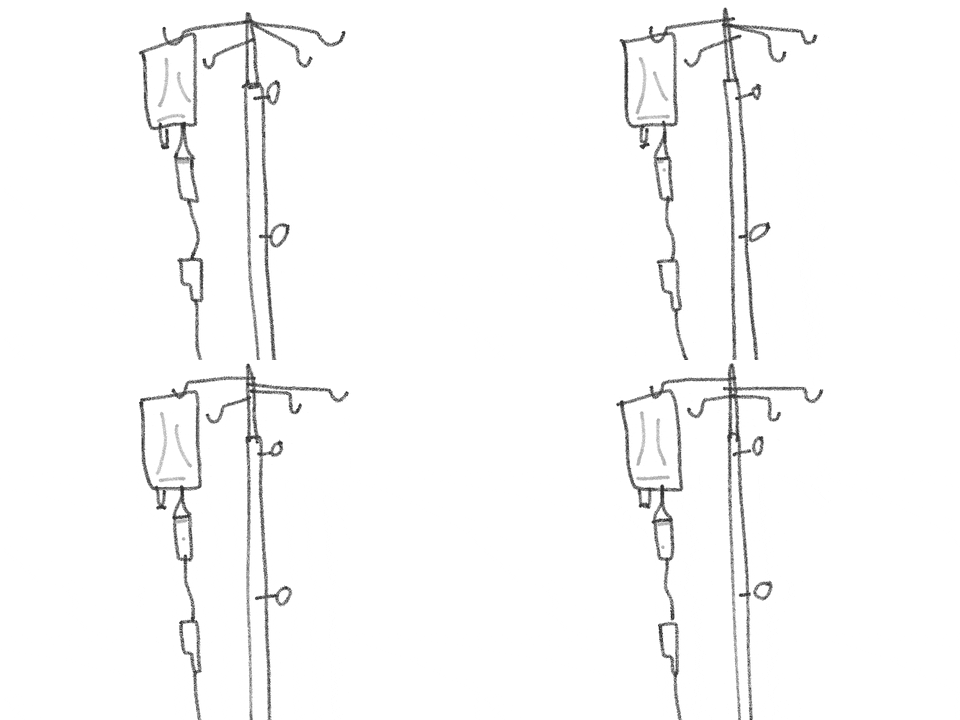
We are seven standing cramped in the narrow windowless kitchen, while in the room next door the nurse can’t get the needle in. We stood back in the daytime and so we stand now—not late but still, it’s been dark a long while, and the little town is blown through with emptiness. A cold, windswept October. The yellowish sixty-watt bulb shines down from the ceiling. The LEDs are glowing over the counters and sink, even the phone screens flicker on and off, but it’s still not enough. It might help to open the fridge—maybe the lamp inside would spill a little light into the hallway, onto the pair of shoes not touched in a month, and the slippers with blackened, worn-down heels. Who moved them from under the bed, and when?
Just a few days ago, my aunt was still sliding her swollen feet into them and shuffling to the toilet. Then it was back to the room, the bed, the pillow under her back—her heavy, swollen legs on the ottoman.
“Need help getting them up?” I’d ask.
“I wouldn’t touch them if I were you.”
They really were heavy, limp too, but not wet like you’d think. Her eyelids drooped. What was there to say? A moment later, she’d be up again. Toilet, room, ottoman. Back and forth. She was fed up with us.
Seven years after her mother would be a bit too soon. In my favorite childhood books, the best adventures wouldn’t start until after the boy or girl was orphaned.
Today everybody’s keeping their shoes on, as if we’re about to head out. We talk in half-whispers. There’s jack to do in this place. We read names off the wall calendar, where my aunt had noted down the dates of everyone’s anniversaries and birthdays. The next one coming up is her daughter Dorota’s, later this month. Of course. We’ll get the next bus, I decide. Marina’s fine with that: “Sin prisa.”
Since yesterday, my aunt’s not had a single drop of water. She just lies there under the comforter, gets that morphine plaster on—or whatever it is they give her—and it’s sleepy time. She keeps coming up then sinking back down, deeper every time. Though that may’ve even started the day before. They don’t want her at the hospital—the hospice will take her when a spot frees up. We’ve cracked the window in her room open, since the radiators are scalding hot and she always hates when it gets stuffy. The net curtain with fake butterflies clipped to it billows out in the draft, touches the nurse’s head, and settles back.
The nutritional shakes sit untouched on the kitchen counter, and, to be honest, I feel like having one. I came straight from work, no dinner, but when they tell me to grab myself one of the shakes, I decline. They’re working their way through a six-pack of beers, softening the lumps in their throats: There’s my father, keeping to the doorway, peeking to see what’s up with his sister; Dorota’s husband, Leszek; their son, Czarek; and my aunt’s son, Tomasz, who just got back from a job in Denmark.
“She’s got me fucked up,” Dorota says for the seventh time now and cries again. She wipes her eyes without taking off her glasses, so the lenses are all smeared.
“Hey, the fact I’m not drinking tonight doesn’t mean I’m looking down on you. I’m here. Let me show you something.”
Marina’s giving me signs not to start. Two days ago, I’d called her over—she had no idea what I’d been up to—and when she entered the room, she saw me floating, hovering a few inches off the floor. “Oh Dios.” I wish I’d seen her face. She loves films about spirit possession and forces me to watch them too. Levitation is easy. You need your feet together, slightly angled—five to twelve, say—with the right foot ahead by half a toe. That’s the one you lift off with. The left leg stays stiff, pulled up by the hip. You need the audience directly behind you, not at the sides—you’ve got to control their perspective. It’s best if you’re sober. Ready? Alright, deep breath.
On that same day, my aunt couldn’t make it more than a couple of steps out of the toilet before heading back in. “I fucking told you: Hand me over.”
“You think it’s that easy.”
Dorota had been driving around town with the paperwork. She sorted it out, but it would still be a wait for a bed at the hospice. Every fifteen minutes, the air freshener let out a mist, and I’d jolt at the hiss, as if someone was crouching behind the drapes, suddenly calling my name. My aunt then asked me to help her sign into her online banking. She got mixed up, repeatedly giving me the wrong login, and I didn’t find any clues in her notebook. That was normal for her. Every so often she’d call saying she couldn’t get into her inbox, so I’d go looking for the scrap of paper with the password: carrot43. This time I got muddled myself. It probably wasn’t even the right bank. She kept pulling things from a folder—documents, bills, her insurance policy. Nothing matched. Hiss. In the end, I gave up. “No worries.”
Deep breath, then up. Like a balloon. That’s how it’s supposed to go. But something keeps me tethered now. My heel keeps hitting the floor. I can’t lift off my toes nor maintain balance. Instead, I show them the photo Marina took. It’s not the same. In it, you can see me from the shoulders down, by a doorframe, so I could’ve been using a pull-up bar—so much for the illusion. Suddenly, Leszek grabs me by the waist and hoists me up, I hit the light with the top of my head, and the bulb pops. The nurse must’ve heard it. Maybe she was just about to get the needle in. We hiss at each other to be quiet—we make quite the snake pit. I shake the glass shards from my hair, and Marina checks for blood. At my aunt’s old apartment, all the family parties would eventually migrate to the kitchen once she went to bed. If we ever got too loud, she’d get up to yell at us. Just imagine that now.
A few more buses, then it’s the night ones left. Czarek calls an ambulance. They won’t come—not unless CPR is needed. But he keeps trying to convince whoever’s on the line. He raises his voice, then apologizes. They ask him something. He doesn’t know the answer, so he takes it to Tomasz, who snatches the phone.
“We’re good, no need for anything, bye,” he says and barges into the kitchen. “You called 999 to my house? Are you out of your minds?” He opens another beer. In a horror film, he’d be one of the first.
“Chill out, man. We’ve got prescriptions for every drug on that table.”
“Can’t you see the lady’s trying to work, kiddo?”
“I’d like to remind you it’s me who got her here,” Czarek says. The nurse is his friend’s mother.
“Cool. Then let her do her job.”
A long sip, head tilted back, Adam’s apple bobbing up and down—and then, from the shadows behind him, a claw reaching out.
“So why the hell are you still hovering over her?” Leszek jumps in.
“Got an expert over here.”
“I’m about to throw every one of you the fuck out.”
“I need a woman,” Dorota says, hugging Marina. They stand there holding each other, while the draft from next door drags in leaves, which land at our feet. Maybe, after all, it’s not a bed in there but a fallen tree, a rotten trunk, and inside it, under the roots and conifer needles, a buried she-bear. She’s growling in her sleep; meanwhile our hearts are pounding.
We’ll live without her.
If she wakes, she’ll eat us.
We’ve been too loud. She’ll enter any minute now, staggering into the kitchen—gaunt, save for the swollen legs.
Tell me right now: Who took my slippers? I’m still breathing.
“Forgive me, sweetheart, I won’t bother you again,” the nurse says. She’s whispering, but we can all hear her. “One last try, I promise.”
When I was helping my aunt with her bank account, she had Around the World in Eighty Days paused on her laptop. It’s one of those games where you line up three to five gems, fruits, or some other shapes in the same color, then they disappear off the screen and shift everything around. She could spend hours on it.
“I’m stuck on this day,” she said, smiling.
She’d gotten far: day seventy-seven. Phileas Fogg was about to win the wager—unless some surprise was still in store. Just the thought of it had the poor guy sweating. Ten days made up one country. If you lost all your lives, you had to start the whole country from scratch. Fucking nightmare. Lucky it wasn’t the whole world.
“Finish it,” she told me.
“I haven’t played in ages. Don’t want to mess up your game.”
She raised her hand and dropped it. Sitting propped up on a pile of pillows as usual, with her legs stretched out on the ottoman, arms at her sides, bent at the elbows.
I perched on the edge of the bed. She stopped me from lowering the volume. The pieces sounded like shattered glass as they lined up and popped. When I was little, she’d gone on a trip to Vienna and kept a ton of photos from the amusement park: She loved chair swing rides, loved whirling 300 feet off the ground, over that great, nonstop clangor of points adding up. Her shoe slipped off into that string of lights.
Soon enough, I blew my last shot at beating day seventy-seven.
Towards the end of the week, I’d texted her saying I’d drop by on Saturday. The reply came right away: Mom’s not using her phone anymore.
Which didn’t mean much.
Right foot forward, left leg stiff.
C’mon, I know how to do the shitty trick.
Yesterday I’d launched the game at home. I burned six hours on it, nearly going blind from all the colors. After day eighty, there’s day eighty-one, the true finale. And right after that, you can start the whole trip again. Phileas Fogg says exactly the same thing as before the first voyage, as if he has no idea he’s repeating himself. And even though you’re bored and exhausted, you really do feel like going again, from the beginning.
On her way out, the nurse passes the stocky freckle-faced woman who’s come to wash my aunt. Now all of us, no exception, stand squeezed into the kitchen. No one steps out, no one peeks over their shoulder. The window is shut, and we’re starting to go a little ripe—we could really use that air freshener in here. And we’re talking louder than before, our eyes sore from the LEDs over the counters. Sharp bits of bulb still jut out from the ceiling light. She couldn’t get the needle in. We’ll have to moisten her lips, hydrate her drop by drop. Except she doesn’t want it, pursing her lips. Marina and I are just standing here pointlessly, sober and bleak—I should’ve left after I said my goodbye. Because when I was alone with my aunt for a moment, just before the nurse came, I crouched down and whispered in her ear what I’d put together a little while ago. I might’ve even prepared it too early, when she still had an appetite and nobody would’ve dared to steal her goddamn slippers.
Leszek turns on the range hood, but it doesn’t help. The stove is polished clean, the dishes all put away. I scrape slivers of ice off the freezer wall with a knife and drop them into a glass of flat Coke. I mean, I’ve never gotten so drunk that I fell asleep on a bus and rode all the way to the end of the line.
“You can grab the rest of them tomorrow,” Tomasz says to the freckle-faced woman, barely visible behind the leaves as she heads for the door. She’s carrying the largest plant pot in her left hand, two more in a reusable shopping bag.
The dracaena and that beautiful orchid. Marina would’ve liked to take a keepsake too—she’s turned our place into a garden—but she won’t speak up, not now or later, and Tomasz won’t offer. Dorota will pick something out for us.
They all step out of the kitchen and into the room, leaving me alone, in the dark—someone’s switched off the light without thinking. Once again, they congregate around the bed, like they’re making sure she’s still there, after everything. Her kids are divvying up night duties: Tomasz will keep watch. Leszek is still on the fence. Dorota and Czarek will take a cab in an hour. My father will walk back—he lives close. In a week’s time, he’ll pin the butterflies from her curtain up in his place.
I’m not going in there. I’ve already said goodbye. I take off my shoes and step my sweat-soaked socks onto the tiles. The cold seeps in. One last try. Feet together, slightly angled. Deep breath. I lift off, left leg drawn up. A bit higher. I wish I’d seen her face. There.
Suddenly, my right leg goes numb—I don’t feel my toes or the cold from the floor—but I keep going. And then, I can’t come back down. I think I really am floating above ground. My scalp feels warm, like the bulb’s still there.
That was the inhale—now the exhale. Still floating.
I’ve put it all together, from beginning to end. Maybe I did it too early.
Her shoe had been found. A guy with graying hair was waving it around, his shirt sleeve stained with blood he’d wiped off his forehead. When she approached him barefoot—it’s easier that way than with a single shoe on—he spoke to her in cheerful German. She looked over her shoulder. The little chair was rocking on its chain. The next round was about to begin. She hoped no one would steal her seat.
Still, it’s better than nothing.
Hanna.
Right. You begin with a name.
Grzegorz Bogdał (@grzegorz_bogdal) is a Polish author and screenwriter. His short stories have appeared in the country’s leading literary magazines. His debut collection, Floryda (Florida, 2017), was nominated for several major awards including the Conrad Award, while his second book, Idzie tu wielki chłopak (Here Comes Big Boy, 2023), won two of Poland’s most prestigious literary prizes, the Gdynia Literary Prize and the Witold Gombrowicz Literary Award. He lives in Kraków.
Dawid Mobolaji (@dawidmobolaji) is a Polish-Nigerian literary translator, writer, and resident doctor based in London. In 2023, he completed the Emerging Translator Mentorship program at the UK’s National Centre for Writing and was awarded a Travel Fellowship by the American Literary Translators Association. His translations have appeared in Words Without Borders, American Poetry Review, The Dial, and elsewhere. His writing has been published in Bending Genres, Flash Frog, and other venues and has been nominated for the Pushcart Prize.