
Negative Spaces
1.
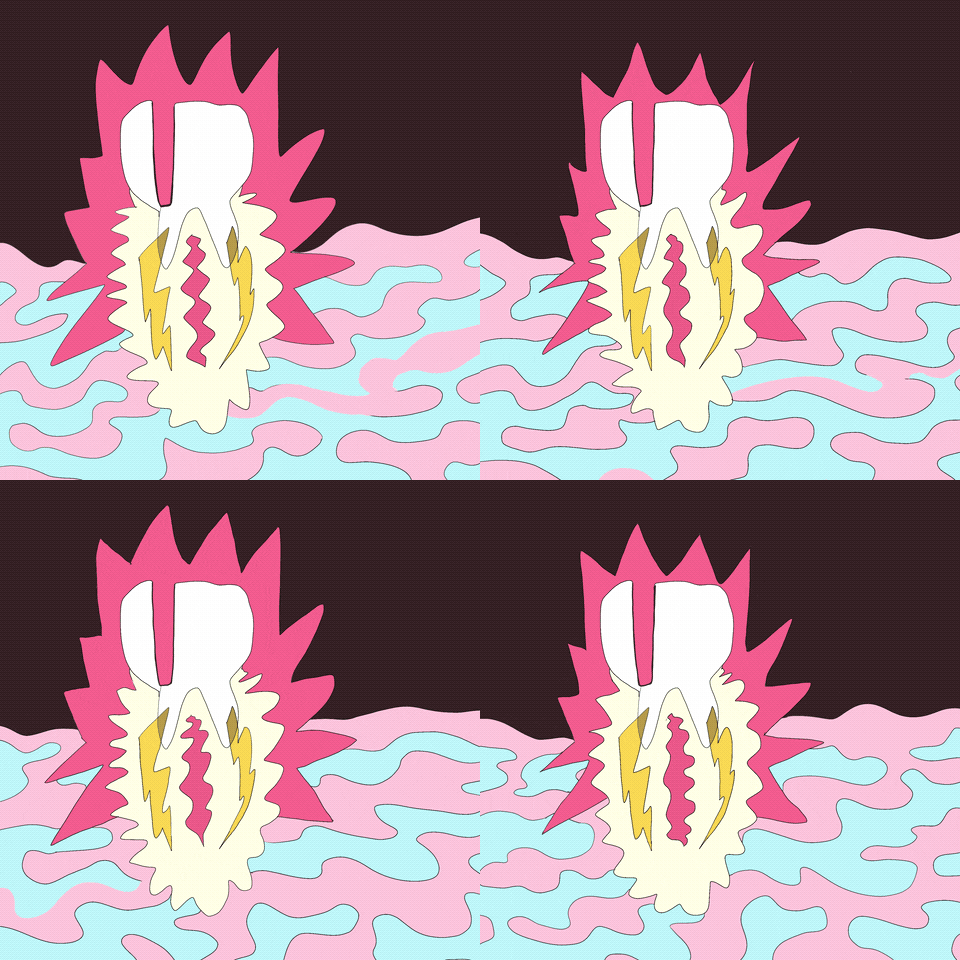
At the urging of a somewhat trustworthy dentist, I had a tooth pulled from the upper-right side of my mouth. Just at the corner of my smile. You can’t see it when I’m unhappy. He said it was one extra, crowding my bite. I argued with the man, of course. I said, I think my body knows what it’s doing. He spoke into my mouth. He said, no, it really doesn’t. He explained the ways this would be bad and would get worse. An off-kilter bite, irregular pressure, jaw pain, strained ligaments, crumbling tooth structure. I said, do you work on a sliding scale? I’m poor and I have the pay stubs to prove it. Yes, he said. For dentistry, yes. He showed the tooth to me after. The root was bigger than the tooth itself, and I began to see his side of things. I could see now how this extra could be a nuisance. I didn’t realize it had all that going on underneath. It’s like what they say about icebergs. When he took the tooth, I was left with a gap and a sizable hole in my gums. The dentist said, sliding scale for dentistry, not for orthodontics, however, and it’ll be several thousand to close up the vacancy. I had concerns, and I let them be known, about the ethics of however-ing a statement from so long before. I left his chair, and the space in my mouth became the semi-permanent home to the tip of my tongue. If I wasn’t speaking or eating, my tongue was in the space, pushing into the gummy divot at the top of my mouth. My face, its muscles, became used to this positioning. But my teeth, the ones I had left, had other ideas. It happened slowly so I didn’t notice, but my teeth started shifting and closing the gap. My tongue became homeless, didn’t seem to fit where it used to go. Nothing felt natural and I was always too aware of where my tongue was and where it wasn’t. There is less matter in my mouth but somehow there is also less room, and the things left behind don’t fit comfortably anymore.
2.
A woman who sleeps outside of the café I work at says the same things to me every day. She says she can leave if I want her to, that I don’t have to make her a coffee, that the free county newspaper we keep by the front door is full of mechanical errors and misaligned on the right side. She says that doorways are warmer than other places she could sleep. Places like under the tall bushes off the parkway or next to the chain-link behind the Pick-n-Pull. I say, what about those spaces under the overpass, those little slits between the wall and the road above it. Oh no, she says, that’s no good. Every morning I have to wake her to get in the door. She sleeps right against it, in the space just out of the weather. Sorry, she says, and I say it back. Sorry. She says a door is touched so often that it holds the heat of all those hands and passing bodies, that it’s practically a living thing. It moves, responds, protects. She says, I used to have a house of course, but I don’t anymore. Of course. She and I have some things in common, one of which is that we are always hungry and often alone. Safety is a thing hard to come by and empty stomachs are hard to fill. I’m palming a shrink-wrapped cookie and thinking about taking it home when the woman surprises me by putting her hand on my wrist. I flinch, pull away. It’s just a reflex, I say, sorry, and she says it back. Sorry. She says she is only coming up to say goodbye. She says she has a line to go stand in, at the end of which is maybe a cot, which isn’t as warm as a door but possibly safer. She says she might not be back. I give her the cookie, the last cookie, and I say goodbye. Goodbye, she says. The woman who publishes the free county paper comes in with the new edition. Hey, I say, hey, why don’t you run that rag through spell-check for once? And don’t you know how to justify?
3.
I’m having a personal crisis from watching professional basketball. I don’t recognize my team anymore. All our favorite players are courtside gurus now, wearing suits with their own names on the labels. When he and I were in the same place we had this shared language: these players whose stances we copied, whose names we yelled while pelting garbage into cans or at each other. But now I see tired bodies sitting on the sidelines. I’m having difficulties with the passing of time and the things that get left. That’s why I stopped doing birthdays and then holidays. I’ve lost track. That’s how I’ve ended up at the sports bar with a date I don’t like while Kobe plays his last game. It snuck up on me. I’ve ordered the TNT basket, which is chicken strips rolled around in hot sauce. Please, I say, please don’t talk to me until the clock runs down. He can’t do it. Be quiet, I mean. But I never thought he could. He says, you and me, we have fun, right? I say, maybe you do, but I do not and I haven’t in a while. Kobe has his hands on his knees, fists full of his own shorts. He is making a career high. He is leaving forever. I can taste the age of the fryer oil in the back of my throat, coating the roof of my mouth. I begin to understand myself as an unpaid guru. A retiree in need of a second act. And I must move quick or risk never moving again. I need my muscles to get warm and loose. I need to look for something even more than I need to find it. So I leave. In the streets, the sun is thinking of setting. I’m attracting mosquitos which are attracting bats, and their swooping in and out makes me flinch. I’ve never been very attached to nature. I’ve never slept outside. I’ve never touched a frog, but I like when they all get going in the bushes by the water. I’m looking for them now. I’m looking for those orange fuzzy caterpillars and what they turn into. I’m looking for those blue mushrooms that grow from tired wood. I’m sticking my head into the hollows of trees. The confetti’s been stuck in the rafters, and I think it’s time to shake it loose.
4.
At Christmas I ride rollercoasters again. I’m on the Thunder Mountain Railroad. I’m a prospector looking for gold. I’m a thief of the natural world, and there’s ghosts in these hills that will set me straight. Any half-decent rollercoaster has a story. I’m riding the rails thinking about the dead and how I wanted him to come with me last year. How I thought it would make him happy. But he couldn’t do it because he wasn’t safe in his own body and his mind wasn’t right. Now he’s not here to invite and it’s Christmas again. I’m saying he’s dead and I miss him. I thought coming this year would make me happy, but I’m feeling unsafe in my own body and I’m not sure if my mind is right. I have been to the mountain top. The thunder mountain top. I’m at the top right now. He did not make it here with me. I can see the edge of the park from here. Chain-link dressed up is still chain-link. I’ve got the gravitational forces of speed, steep drops, and deep, irreparable sadness pushing me around. My hips clash against the side of the car, I don’t fit the same as I used to. That’s what the safety bar is for. It’s light foam covering. It’s wipe-clean vinyl. Sad on a rollercoaster. Even I can see the humor in that, but not enough to make me smile. It’s nice they don’t take photos on this one. In this story, there’s a disaster. An error involving all our safety. Me and everyone else on this train. A fuse is lit, the ghosts in the hill lit it, and the flame chases us through the tunnels. There is steam and smoke and sparks, then an explosion, and we barely make it out in time before the TNT ignites and the mountain walls collapse behind us in a racket of falling rock and fire. The little girl in the car in front of mine turns back to look. To see if it really exploded. To see if it was real. She checks to make sure we’ve survived something.
Miranda Manzano (@miranduh_m) is from Northern California, lives in Washington State, and writes fiction. She is a graduate of Eastern Washington University’s MFA program in creative writing.