
Gaffney Is Born
content warning: suicide
Gaffney is born in the middle of an armistice between his mother and sleeping pills. His mother, Leila, gasps and struggles in the hospital bed. Push, the doctor says. Guhhunhh, Leila says. I Quit Sucking My Own Dick to Be Here, Gaffney’s father’s T-shirt says. He’s a man who wears shirts like this.
Gaffney’s born special, because Gaffney’s born smiling.
* * *
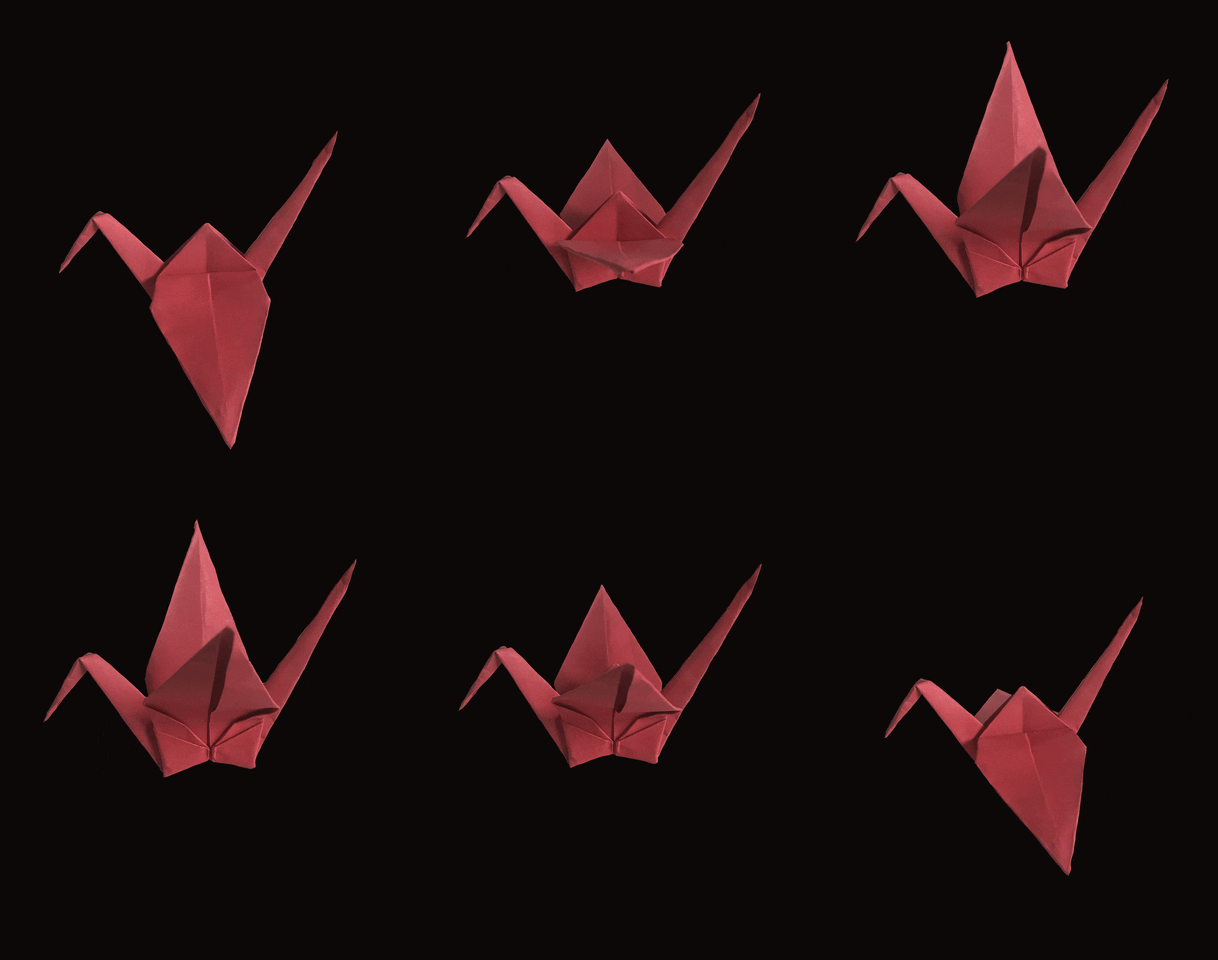
Gaffney’s two; his father shows him a magic trick. He pretends to eat a paper crane, massages his throat, spits it back up. He unfolds it, and a love note’s written inside. Many such cranes carry these messages of hope in the folds of their origami wings.
For my little pumpkin head, Gaffney’s father says. Here. You try.
Gaffney’s father hands the boy a series of perfectly folded cranes. There’s no spare crease, no mismatched or overlapping edge. And inside, the cranes might say things like, Sacred love arises from the depths of human suffering or Milk, toast, eggs, beer, batteries—maybe that one’s a mistake. Whatever’s written on this crane, however, is lost to time because Gaffney accidentally swallows it and then gags, and his stomach is fucked, and they rush him to the urgent care for an X-ray and a pill to induce vomiting. How many are in there? Leila hisses at Gaffney’s father, and he grabs his hair, stressed out. He’s always been bad at math.
Gaffney’s father is a free spirit, a champion of peace, a radical lover. He claims to have enough love for the entire planet. Yes, there are bills and debts and the repercussions of Leila’s addiction to sleeping pills, yes, there are the burdens laid one over the other on top of him, not crucifixes but Sisyphean boulders of bullshit, and his own trauma to boot, but he turns a smiling face to the world anyway, because he has chosen happiness. Honk If You’re Horny, his shirt says. Horns around the nipples. Of course he’s unemployed.
You’re a fuckup, Leila says that evening, still mad about the cranes.
Come over here and kiss me, Gaffney’s father says, and sometimes, when they’re angry or hateful or feeling especially alone, the two can kiss in a way that feels like the first time, or better, and if love could make them weightless, not just in sensation but actually weightless, Gaffney would have to get a broom and knock his father from the ceiling every other day.
Sorry to barge in on your story, but I’m hiding over there in the tiny gap in which the sunlight licks the blinds, feeling awful about what’s going to happen.
* * *
Gaffney’s three, swimming. The beach is a place in motion: waves cresting, rash-guarded men falling in the short rippling surf, and a fraction of sun peeking out from dimpled clouds. Further along, there’s a pelican which will always be too far away, no matter how much Gaffney paddles in his floaties.
Gaffney’s parents are kissing on the shore. Really sucking face.
Kick, kick, paddle, paddle. The waves on the Gulf coast of Florida are so shallow, so warm, and Gaffney bobs along the surface like one of his duckies in the tub. Pelican ahead, parents behind, he spreads his arms out and splashes. He makes a gurgling noise, one that starts in the back of his throat and rises. Unh unh, he says, cupping the silky water.
What’s wrong with Gaffney? his father asks.
Right now there’s nothing wrong with Gaffney. The kid is simply in love with being alive. Yes, there are arguments and broken dishes at home, yes, there’s the crushing asphyxiation that comes from owing a lot of money to a lot of systems, but Gaffney doesn’t know about all that. His life is full of immediate beauty. The waves like a hundred little mouths blubbering infinite kisses on his skin.
* * *
Gaffney’s four; his father sleeps too often. Gaffney bounces on the edge of the bed. Dad, he says. Dad dad dad. Daddaddaddaddad.
He wishes his father would get happy or angry or sad, but he doesn’t do anything. And sure, money’s gotten tighter and affection has grown bitter and Leila was caught typing WHERE CAN I FIND DRUGS into her phone one night, but this is a man who has love enough for the whole planet. This is the happiest man Gaffney has ever seen. And these are supposed to be happy memories. It’s supposed to be happy memories all the way down.
Gaffney leaps on top of his father. His father turns sideways. That’s a heavy shape pressed into the memory foam.
I’m living in the fabric-worn, pale patch of lampshade where the light comes through just a little bit cleaner. How does one intrude on a memory? With hands to face, blushing.
The lampshade grows faintly pink.
* * *
Gaffney’s five, having trouble remembering something. Every time he tries to think on it, it comes up blank. He feels a little bit ashamed. Isn’t memory loss for old people?
He misses his father. His father’s somewhere inside this gap in memory. One second, he’s hopping on the bed, and the next, Leila’s walking around the house in his father’s shirts. Didn’t Ask, Don’t Care.
Gaffney wants to bridge this gap in memory, wants to ask his mother where his father went, but Leila just cries and cries. Oof, Gaffney thinks to himself. This memory loss is serious business. He would much rather play.
So he finds a cool bush in the backyard. It’s tucked away just over the fence, hidden in plain sight, boughs open like a soft green maw, inviting him inside.
The bush is even prettier up close, blessed by an enticing shade. Little roughshod trails of dirt cut in and out, large enough for Gaffney to scrape by on his hands and knees. Wow, Gaffney says. He crawls inside, brushing pine needles away with his palms.
He emerges in a tiny clearing, barely large enough for two or three people to huddle together, a dusty place that smells like wood and sand and the gas station further on. Two middle schoolers are giving each other piercings. Hey there, kid, they say to Gaffney.
Hey, Gaffney says.
Want a piercing?
Nah, Gaffney says. The air is very still here. A delicious cool settles over the three of them. Is this heaven? Gaffney asks.
Damn, kid, the middle schoolers say.
Gaffney returns to this spot under the bush every day after school. Leila has no idea where he is, but I do. I’m behind the bush, watching him.
I can’t rewrite the past, and what purpose would it serve? I’m writing towards a future, and I worry that each word is more inadequate than the last.
A bush hugs the way a father might: only for as long as you press back.
* * *
Gaffney’s six, and Leila has decided to burn all of Gaffney’s father’s shirts. Goodbye to Fluent in Sarcasm, goodbye to Sixty Percent Funny, Fifty Percent Bad at Math, goodbye to I’m Sexy and I Mow It. Lawnmower printed beneath. You can’t trust a man like that, Leila says. A man who wears ironic shirts. Humor can’t just be a catch-all, a comforting lie. Her eyes are red-rimmed.
Gaffney watches the fire rise higher into the night, orange licks of flame and sweet, strange-smelling smoke. He squeezes his mother’s hand, relishing the contact.
You don’t choose who you love, Leila says.
Gaffney squeezes his mother’s hand tighter.
He got me off pills, Leila says.
Tighter.
What’s going to happen to me? Leila says.
A little tongue of fire licks the wooden patio furniture. Gaffney wonders if this is perhaps not the safest thing in the world.
* * *
Gaffney’s seven. For the last time, he crawls into the bush.
He shuffles across dirt, pushing aside leaves and emerging into this soft cocoon hollowed out in his secret space. Heaven has a visitor. The world is a funnel, drawing Gaffney to this man sitting cross-legged on the ground. It’s been a while, but the angular face, the scraggly sideburns, the slight snaggletooth embedded in a pearly grin are all the same, preserved as perfectly as Gaffney can remember.
Fish Fear Me, Women Love Me on his hat.
Daddy! Gaffney cries.
Gaffney’s father is all long limbs unspooling and smile lines. The thinnest sliver of sun slants through a bough, peppering his face.
The light, in many uniform creases, creates a ribbing which, at second glance, imitates a shuttered blind.
I’m on the other side of that sunbeam.
Two years have passed since his father disappeared, but to Gaffney, it’s barely a minute. He presses his head into the soft paunch of his father’s stomach and nuzzles him—scent of cognac and sweat. I missed you, Gaffney says.
Somebody hold him down, or he’ll float away.
Gaffney’s father cups his hands over Gaffney’s face, turns him this way and that, looking at his meek, kind son. Unh, unh, he says.
Gaffney drops his father’s hands.
Unh, unh, his father says again.
Now the space under the cool bush shrinks, closing in on them, the boughs drawing together until they form flat, colorless drywall. Gaffney smells pennies. This is what he’s been forgetting. This is what his brain has kept from him for two years.
They aren’t really under a bush, are they?
They’re in the living room.
Gaffney’s father has just shot himself in the head.
Now everything comes flooding back. The closed blinds, the coin-scented blood. And, in the space where his father’s jaw used to be, a hole—the open skin baby-gum pink, the cavity gasping and wheezing like some kind of mouth. Unh, unh, the cavity moans, as if it is a thing alive, red bubbles forming and popping in the vacant spot where vital matter once was, that same matter dribbling down his shirtfront.
I’m With Stupid written on his shirt. Arrows pointing in all directions.
Gaffney, Leila says, opening the door. You didn’t help me carry the groceries.
A paper bag bursts; an apple rolls across the hardwood.
* * *
In the eighteen years between then and now, Gaffney and I meet.
We are a portrait of fast friends. We detest the same things. We beat each other to punch lines. And, when the light hangs its hat on this city, it hangs the same way for each of us: slanting, edgeways, dotted and mottled. Not a triumph, but a lament.
Our friendship is a series of private jokes.
Tsar Bomba was the heaviest nuclear warhead, I say.
And now, three pizzas heavier, Gaffney says.
Because we are modern men, we cannot speak a thing to each other about mental illness. We communicate instead through art and letters. The note doesn’t fold perfectly, and it hitches going down. Here’s a Post-It, a Mad Lib, a doodle, left on the fridge after crashing on the couch or pressed in between the windshield wipers of each other’s cars. It’s two in the morning, and we are high on drugs, fingerpainting. Those roses look like blood, I say, and Gaffney bursts into tears.
No, Gaffney, I say. Really pretty blood.
Gaffney’s memory is a lockbox, and all I have is the paper clip holding this story together. Is a reconstruction of the past a historical document or an emotional paperweight? I often worry that I’m good for a little joke and not much else. And I’m terrified of this question: What if I can’t help you?
Gaffney and I move to different cities, but stay in contact. USPS will ship a letter written on cardstock, or the back of an overdue bill, or the inside of a thrifted T-shirt. These things are oblique and coy, sarcastic as hell, but in the dead of night I can hear the artifacts breathing.
Gaffney would never say, Help me.
Or, I’m struggling.
Or, I need someone to talk to.
But at two in the morning I receive a phone call I’m not awake to answer.
A sunrise is a form of penance, wherein I pray that I’m not too late.
* * *
Gaffney’s twenty-five. Watering plants in the garden center.
Gaffney!
Or maybe he’s seven, reliving the moment in which his repressed memory came back to him. Or maybe he’s five, reliving the actual moment of his father’s suicide. Time is a professional driver on a closed track. The car keeps circling, covering the same ground over and over.
Gaffney!
There have been a million horrors since then: Leila’s relapse on sleeping pills, the way she fell asleep in bed on those same pills, cigarette in her mouth. Rounding the corner after school and seeing the million cars out front, the thick black smoke disappearing into the air, the brittle bones of the only home he had ever known, and his mother on an ambulance step, shaking her head. The foster system, with its endless capacity for cruelty. Abuses so terrible they aren’t worth repeating. So numerous that any single one seems trite. It’s been a million horrors, yes, but it always goes back to the first one, and maybe this isn’t chemically accurate, but it must’ve been this memory, finding his father there in the living room, that took all the joy out of him, sucked, crumpled, like a juice pouch.
He’s only twenty-five. He feels so much older.
Gaffney! Martha grabs the watering can from his hand. The ficus is now swimming in its pot. You’re completely spaced out, Gaffney, Martha says. Why don’t you take the afternoon off, get some rest, come back in the morning ready to work?
This is one moment, but it could be any. It’s been lurking for a long time, stalking him, watching, waiting. He had an intuition of it last night and, unable to sleep, called his friend. The quiet one.
No reply.
I quit, Gaffney says.
He takes off the orange apron, lays it neatly on the counter. I appreciate everything you’ve done for me, he says. You’re a good manager; I mean it. And he does. Gaffney goes to the patio section, takes a bug zapper off the shelf, and walks out.
* * *
Gaffney’s apartment smells like necrosis and Clorox wipes. Boxes of old pizza in the corner, a blender full of indiscriminate sludge. Gaffney stands at the threshold. The power goes out. He has so many cockroaches in his apartment that they trip the breaker. They’re drawn to the warmth in the fuse box.
Gaffney opens the fuse box and pushes a finger into the gap. A little shower of cockroaches. The power comes back on with an electrical shiver.
Fifteen new messages, his voicemail says then beeps.
Hey man, I just saw your call, sorry I was sleeping—
Hey man, is everything—
Hey man—
A cockroach runs over his foot. He doesn’t move, just closes his eyes.
Gaffney goes to the bathroom and looks in the mirror. He spies his tired irises, quivering dots suspended under a shaved head, a ruddy face, a roan beard that he can’t ever quite figure out what to do with. He strips naked. He’s got tattoos that cover up scars, that overlap and cover up other tattoos. He’s got a hairy chest, a skin graft, rods on his nipples. He hates what he sees.
Gaffney takes the bug zapper out of the box, plugs it in, watches as it crackles to blue life.
Gaffney stops the drain. Begins to run the bath.
* * *
The bathtub is ancient. There’s a crack in the backsplash, a rip running across the blue suns embedded in the tile. When it rains, the crack weeps moisture. But when it’s dry, like tonight, the tiniest pale light gets through.
This is what depression is like: The longest, loneliest second of your life curls up inside you and dies, slowly, in the hole in your father’s head, in the gap that exists between all that you’ve hoped for and all that you’ve lost, and somewhere in the length of that second your brain tells you nothing on earth can be worse than this. And then that second passes. And the next one comes.
And this one is so much worse.
Did he really used to kick, kick, paddle, paddle so lightly through the ocean? The good things seem so distant, and the bad things are right there in his face, and he knows how this will turn out. There’s no more room for surprises. He was born alone, and he’ll die alone, and death will be a relief, an end to something that wasn’t even worth a beginning.
And then I say, Gaffney.
Gaffney looks around. His eyes land on the crack in the tile.
Get in here, motherfucker.
Gaffney puts his hand in the crack. He feels the air, warm, soft, pulling on him like a current, inviting him. It’s larger than it looks. It expands to meet him.
Gaffney crawls inside.
* * *
We sit underneath the boughs of the trees, our palms in the pine straw. You leaf through the pages I’ve given you, then put them down. I don’t mind being Gaffney, you say, But you could’ve made him a little better-looking.
Sorry about it, I say. I only ever have about a twenty percent grasp on what I’m doing.
The sky is a cerulean pastiche overhead. It looks so far away. The trees like green giants, stepping over and around us.
I’m sorry I wasn’t awake for your call, I say.
You shrug. Break a piece of pine straw in half. Doesn’t matter, you say. It’s embarrassing. My brain just doesn’t work right. You pick a clump of grass, scatter it. No wind.
Please don’t do this, I say.
You’ll miss me for a while, but then it’s over. You’ll forget. The world moves on.
You’re wrong, I say. You couldn’t be more wrong.
You don’t say anything for a while. We express ourselves best in the silences. I’m sorry it’s hard to open up, you say.
I’m sorry I don’t have the perfect line, I say.
The perfect line often comes out cutesy, you say. The cutesy stuff makes me want to puke.
So then puke.
* * *
In the bathroom, Gaffney tries to vomit. He can’t keep this sadness, this contempt, this hopelessness inside him any longer. He opens his mouth; an origami crane tumbles out.
Callback, Gaffney says to the crack in the tile. Very clever.
USPS ships direct to your stomach, I say.
I’ve got to stop eating magic birds, Gaffney says.
And if there’s an epiphany riding on these wings, then yeah, maybe Gaffney will live forever. But if it’s just some small, tender something, a joke, a comfort, a prayer, then maybe Gaffney will stick around until tomorrow, to see if another crane’s coming.
Gaffney reads the crane.
The crane reads, Life’s a Beach.
I’ve got enough of these to last the rest of your life, Gaffney. If you’ll wait around that long.
That’s a fortune in postage, Gaffney says.
And I need you to understand how wrong you are.
This is no cost at all.
Brett Hymel Jr. (@bretthymeljr) writes stories for bugs. These stories have appeared in several publications, including The Cincinnati Review, Subtropics, Black Warrior Review, and Puerto del Sol. His website is www.bretthymeljr.com. He pays an embarrassing amount of money to keep the domain running, so please click the link.